238 Log 250807 Toshie Kakinuma:
Joji Yuasa and the Apparatus Called Language_Part II
Joji Yuasa and the Apparatus Called Language_Part II
Abstract Part II
Part II explores how Yuasa’s groundbreaking composition Voices Coming redefined the relationship between voice, sound, and meaning.
Yuasa used recorded human speech rather than newly produced sounds, emphasizing how voice inherently carries meaning. Through fragmentation and editing, he suspended meaning and broke down normal communication, turning language itself into musical material. Dismantling question–answer structures and expose the emptiness of habitual speech. Kakinuma compares Yuasa’s approach to Luciano Berio and John Cage, highlighting Yuasa’s distinct focus on the phenomenology of language. Over time, Yuasa expanded these ideas into live and instrumental works, maintaining speech-like rhythms even without actual words. The essay concludes that Voices Coming forms the philosophical and artistic foundation of Yuasa’s career, revealing how fragile and yet vital communication is in the modern world.
Toshie Kakinuma
Born in Shizuoka prefecture, Japan, Toshie Kakinuma is a distinguished musicologist, critic, and translator whose work centers on experimental and vocal music of the 20th and 21st centuries. She received her Bachelor of Music in Musicology from Kunitachi College of Music in 1977 and went on to complete her Master’s degree at Ochanomizu University in 1981. Pursuing further research abroad, she earned her Ph.D. in Music from the University of California, San Diego in 1989, where her doctoral studies focused on the American composer and instrument maker Harry Partch. Upon her return to Japan, Kakinuma held teaching positions at several institutions, including Meiji Gakuin University and Takushoku University, before joining the faculty of Kyoto City University of Arts as Professor of Musicology. At Kyoto, she also served as Director of the Archival Research Center, contributing significantly to the development of resources on contemporary Japanese and American music. Her scholarly interests encompass American experimentalism, modern Japanese composition, organology, and the intersections of sound, language, and the body. Kakinuma is the author of American Experimental Music as Ethnic Music (Film Art Sha, 2005) and The Birth of “Atonality” (Ongaku-no-tomo Sha, 2020, The 30th Yoshida Hidekazu Prize), has written extensively on figures such as Yūji Yuasa, Tōru Takemitsu, and Lou Harrison. In addition to her critical and scholarly output, she has produced influential Japanese translations of key 20th-century music texts, including John Cage’s Silence and Alex Ross’s The Rest Is Noise. When she wrote her essay “Yūji Yuasa and the Apparatus Called Language” (Ongaku Geijutsu, October 1984), Kakinuma was an emerging voice in Japan’s critical and academic circles, closely engaged with the evolving aesthetics of postwar vocal and electronic music.
Jōji Yuasa (1929–2024)
was a Japanese composer and one of the pioneers of postwar Japanese avant-garde music. He studied composition in Japan and Europe and was influenced by Western modernist trends (like Olivier Messiaen, Pierre Boulez, Karl-Heinz Stockhausen). He was known for his experimental, combining Western avant-garde techniques with Japanese aesthetics. He worked extensively with serialism, electronic music, and open-form composition.
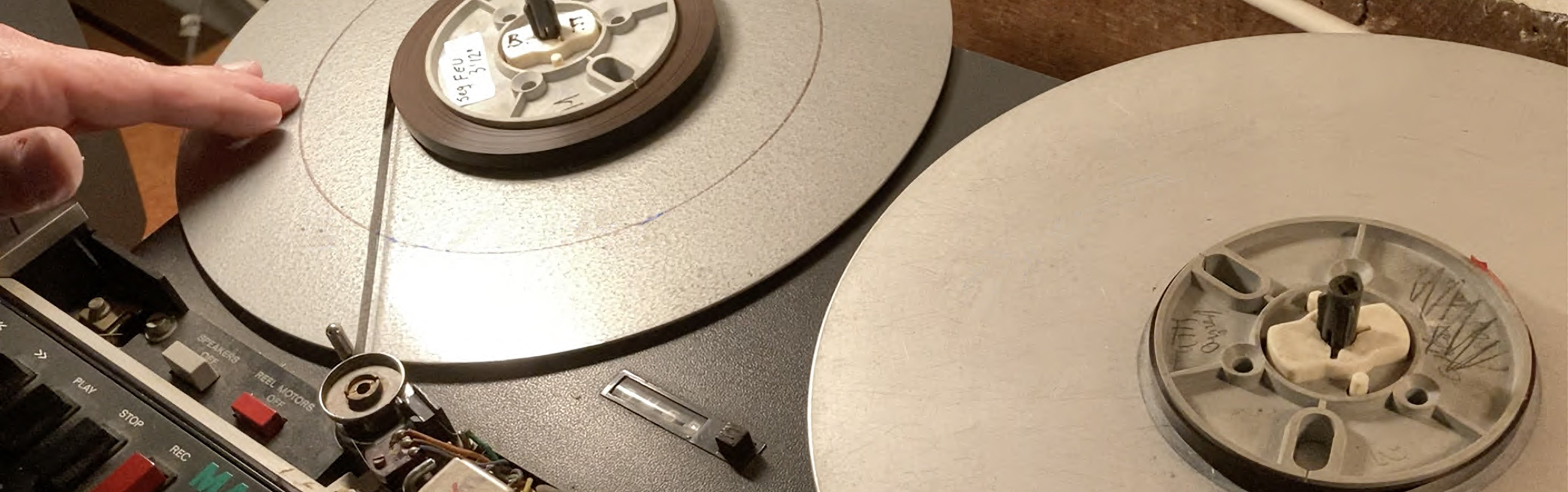
Yuasa’s Work with the voice was an exploration of vocal timbre. He was interested in the human voice as a sound source, not just as a carrier of text or traditional melody. He often treated the voice like an instrument, exploring extended techniques (whispering, shouting, overtones, glissandi), integrating it in Musique Concrète and Electronic Music, experimenting with tape manipulation of the voice, cutting, layering, and processing vocal sounds to create textures and sonic landscapes. The voice became material for composition, abstracted from semantic content. He composed pieces for solo voice, mixed ensembles, and electronic setups. Vocal performances were often experimental, and performers had to explore unconventional sounds and interactions with electronics or tape. Like Tōru Takemitsu, Yuasa was interested in the “sound itself”, focusing on timbre, gesture, and expressive potential of the voice. The voice could evoke natural or bodily phenomena or serve as an abstract sonic object in avant-garde composition.
Jōji Yuasa is a central figure in postwar Japanese experimental music who treated the human voice as an instrument and sonic material, exploring both acoustic possibilities and electronic transformation. His work aligns with broader trends in Japanese musique concrète, emphasizing sound over meaning.
further reading:
Joji Yuasa and the Apparatus Called Language_Part I
Joji Yuasa and the Apparatus Called Language_Part III