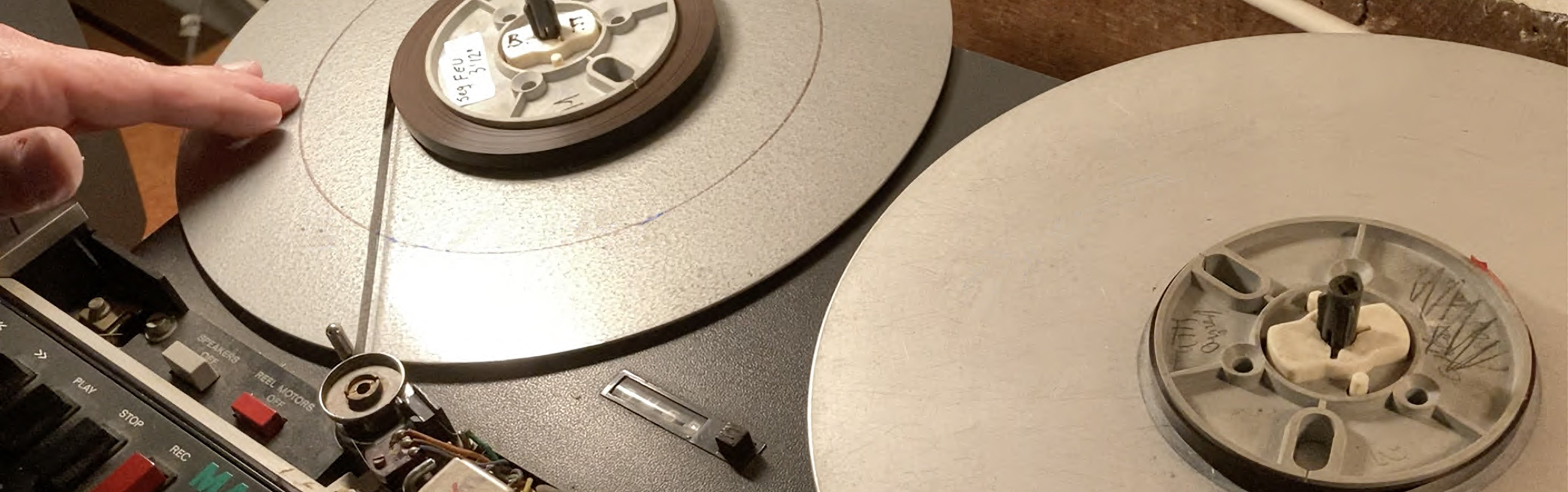
Tonbandmaschine und Stimme
pour le français, veuillez faire défiler la page
for english please scroll down
In der Analyse der Musik der Nachkriegszeit stehen traditionelle Notationssysteme im Zentrum. Die Werke werden in der Regel anhand von Partituren und deren Erweiterungen in Form von Legenden und Grafiken betrachtet, die eine fortschreitende Innovation des musikalischen Materials suggerieren. Dabei geraten allerdings vor allem die strukturellen Parameter der Musik in den Fokus. So wurden Werke, die sich technischer Verschriftlichungssysteme bedienen, wie sie seit dem Anfang des 20. Jahrhunderts mit dem Tonband existieren, ebenso vernachlässigt wie zahlreiche Werke zeitgenössischer Musik, die sich einer ausschliesslich semiotischen Beschreibung strukturell entziehen.
Am historischen Anfang des audiotechnisch-physiologischen Schreibens mit Stimmen stehen unter anderem die Werke der französischen ultra-lettristischen Stimmkünstler und Avantgardisten François Dufrêne (1930–1982) und Gil Joseph Wolman (1929–1995), die ihre poésie physique ohne Partitur direkt auf Tonband produzierten. Davon ausgehend werden die historischen Anfänge des Komponierens medialer Stimmen untersucht, die das komplexe Zusammenspiel von Stimmführung, Umgang mit dem Mikrofon und die technisch-kompositorische Handhabung des Tonbands thematisieren.
Die beiden Verschriftlichungssysteme, die symbolischen Schriften des Lettrismus und die ultralettristische Tonbandverschriftlichung, haben verschiedene Artikulationsstrategien zur Folge: als lettristisch gelten Obstruktionen der sprachlichen Artikulation, artikulatorische Shortcuts und das Laut-Geräusch-Kontinuum ausgehend von den Sprechlauten. Lettristische Artikulationen sind nachsprachliche Transformationsprozesse. In den Buchstabenzeichen ist die Stimme als sotto voce gegenwärtig. Zwischen diesen sotto voce der Schrift und der stimmlichen Umsetzung öffnet sich ein Spalt. Im Gegensatz dazu heben die ultra-lettristischen Artikulationen durch Mikrofon und Tonband den Bruch zwischen Schrift (als technische Aufzeichnung) und Stimme auf, sie gelten als ein exemplarisches Schreiben mit Stimmen. Mit dieser ultra-lettristischen, technisch-physiologischen Stimme entsteht ein medialer Stimmkörper, der das Schallterritorium der Stimme verändert, er vergrössert es. Weiter schafft er earcons (akustisch Icons) der körperlichen Nähe durch die Platzierung des Mikrofons vor dem Mund und dem Hörbarmachen der Atemgeräusche. Nicht zuletzt erzeugt er Effekte einer Stimme ohne Ansatzrohr durch das direkte Zusammenspiel von Mikrophon und Phonation im Rachenraum. Die technische Verschriftlichung ist perfekt in die Stimmgebung (in den Hör-Sprach-Kreis als Voraussetzung jedes Lautwerdens der Stimme (Friedrich/Bigenzahn/Zorowka 1994) integriert und erweitert diese zu einem audiotechnisch-physiologischen Artikulationsprozess. Die Körperspannungen (Tonus), die mit den stimmphysiologischen Prozessen zusammengehen, werden aber nicht aufgezeichnet. Die ultra-lettristische Maxime, alles Ausserphysische im Prozess des Stimme-Machens abzustreifen gelingt nur mit Abstrichen. Die Anfänge der tonbandgestützen poésie physique zwar stehen für eine maximale authentische Aufzeichnung der Stimme, aber sie stehen auch für deren absolut tonuslose Wiedergabe. Dieser Widerspruch charakterisiert die technisch-physiologischen Stimmen.
Magnétophone et voix
Les systèmes de notation traditionnels sont au cœur de l’analyse de la musique de l’après-guerre. Les œuvres sont généralement considérées à partir des partitions et de leurs extensions sous forme de légendes et de graphiques, qui suggèrent une innovation progressive du matériau musical. Toutefois, ce sont surtout les paramètres structurels de la musique qui sont mis en avant. Ainsi, les œuvres qui utilisent des systèmes de transcription technique, tels qu’ils existent depuis le début du 20e siècle avec la bande magnétique, ont été négligées, tout comme de nombreuses œuvres de musique contemporaine qui échappent structurellement à une description exclusivement sémiotique.
Au début historique de l’écriture audiotechnique et physiologique avec des voix, on trouve entre autres les œuvres des artistes ultra-lettristes et avant-gardistes français François Dufrêne (1930-1982) et Gil Joseph Wolman (1929-1995), qui ont produit leur poésie physique sans partition, directement sur bande magnétique. A partir de là, les débuts historiques de la composition de voix médiatiques seront étudiés, en abordant l’interaction complexe entre la conduite de la voix, l’utilisation du microphone et le maniement technique et compositionnel de la bande magnétique.
Les deux systèmes d’écriture, les écritures symboliques du lettrisme et l’écriture sur bande magnétique ultra-lettriste, ont pour conséquence des stratégies d’articulation différentes : les obstructions de l’articulation linguistique, les raccourcis articulatoires et le continuum son-bruit à partir des sons de la parole sont considérées comme des stratégies d’articulation lettristes. Ces articulations sont des processus de transformation post-linguistiques. Dans les signes alphabétiques la voix est présente en tant que sotto voce. Entre ce sotto voce de l’écriture et la réalisation vocale s’ouvre une brèche. En revanche, les articulations ultra-lettristes par microphone et bande sonore suppriment la rupture entre l’écriture (en tant qu’enregistrement technique) et la voix, elles sont considérées comme une écriture exemplaire avec des voix [Schreiben mit Stimmen]. Avec cette voix ultra-lettriste, technico-physiologique, se développe un corps vocal médiatique, qui modifie le territoire sonore de la voix, il l’agrandit. Il crée en outre des earcons (icônes acoustiques) de proximité physique en plaçant le microphone devant la bouche et en rendant audibles les bruits de respiration. Enfin, il crée les effets d’une voix sans conduit vocel grâce à l’interaction directe du microphone et de la phonation dans la gorge. La transcription technique de la voix par le microphone et la bande magnétique est parfaitement intégrée à la vocalisation (dans le cercle auditif-linguistique comme condition préalable à toute vocalisation (Friedrich/Bigenzahn/Zorowka 1994) et l’étend à un processus d’articulation audiotechnique-physiologique. Les tensions corporelles (tonus) qui accompagnent les processus physiologiques de la voix ne sont cependant pas enregistrées. La maxime ultra-lettriste de se débarrasser de tout ce qui est extra-physique dans le processus de production de la voix n’est réalisée qu’avec des compromis. Les débuts de la poésie physique sur bande magnétique représentent certes un enregistrement maximalement authentique de la voix, mais ils impliquent aussi une restitution totalement dénuée de tonus. Cette contradiction caractérise les voix technico-physiologiques.
Tape recorder and voice
Analysis of music from the post-war period focuses on traditional notation systems. The works are usually viewed on the basis of scores and their expansions in the form of legends and diagrams, which suggest a progressive innovation of the musical material. However, the focus is primarily on the structural parameters of the music. Works that make use of technical recording systems, such as those that have existed since the beginning of the 20th century with the tape recorder, have been neglected, as have numerous works of contemporary music that structurally defy an exclusively semiotic description.
The historical beginnings of audio-physiological writing with voices include the works of the French ultra-lettrist voice artists and avant-gardists François Dufrêne (1930-1982) and Gil Joseph Wolman (1929-1995), who produced their poésie physique directly on tape without a score. Based on this, the historical beginnings of composing medial voices will be examined, focusing on the complex interplay of voice leading, handling the microphone and the technical and compositional handling of the tape.
The two writing systems, the symbolic writings of Lettrism and the ultra-lettristic taperecordings, result in different articulation strategies: obstructions of linguistic articulation, articulatory shortcuts and the sound-noise continuum based on the speech sounds are considered Lettristic. Lettrist articulations are post-linguistic transformation processes. The voice is present in the letter signs as sotto voce. A gap opens up between this sotto voce of writing and the vocal realization. In contrast, the ultra-lettristic articulations by microphone and tape cancel out the break between writing (as technical recording) and voice; they are regarded as exemplary writing with voices. Ultra-lettrist articulations are pre-linguistic transformation processes of the voice. This ultra-lettrist, technical-physiological voice creates a medial vocal body that changes the sound territory of the voice, enlarging it. It also creates earcons (acoustic icons) of physical proximity by placing the microphone in front of the mouth and making the sounds of breathing audible. Finally, it creates the effect of a voice without vocal tract through the direct interaction of microphone and phonation in the throat. The technical transcription is perfectly integrated into the vocalization (in the hearing-speech circle as a prerequisite for every vocalization (Friedrich/Bigenzahn/Zorowka 1994) and expands this into an audio-technical-physiological articulation process. However, the body tensions (tonus) that go hand in hand with the vocal physiological processes are not captured. The bodily tensions (tonus) that accompany the physiological processes of vocalization are not recorded. The ultra-lettrist maxim of stripping away all extraphysical elements in the process of voice production is achieved only with some compromises. While the beginnings of tape-based poésie physique indeed represent a maximally authentic recording of the voice, they also result in an absolutely toneless playback. This contradiction characterizes the technical-physiological voices.