238 Log 250807 In Conversation with Toshie Kakinuma:
Jōji Yuasa, Takemitsu Tōru and Japanese Musique Concrète

September 16, 2025, Kunitachi Library, Tokyo

Toshie Kakinuma
Born in Shizuoka prefecture, Japan, Toshie Kakinuma is a distinguished musicologist, critic, and translator whose work centers on experimental and vocal music of the 20th and 21st centuries. She received her Bachelor of Music in Musicology from Kunitachi College of Music in 1977 and went on to complete her Master’s degree at Ochanomizu University in 1981. Pursuing further research abroad, she earned her Ph.D. in Music from the University of California, San Diego in 1989, where her doctoral studies focused on the American composer and instrument maker Harry Partch. Upon her return to Japan, Kakinuma held teaching positions at several institutions, including Meiji Gakuin University and Takushoku University, before joining the faculty of Kyoto City University of Arts as Professor of Musicology. At Kyoto, she also served as Director of the Archival Research Center, contributing significantly to the development of resources on contemporary Japanese and American music. Her scholarly interests encompass American experimentalism, modern Japanese composition, organology, and the intersections of sound, language, and the body. Kakinuma is the author of American Experimental Music as Ethnic Music (Film Art Sha, 2005) and The Birth of “Atonality” (Ongaku-no-tomo Sha, 2020, The 30th Yoshida Hidekazu Prize), has written extensively on figures such as Yūji Yuasa, Tōru Takemitsu, and Lou Harrison. In addition to her critical and scholarly output, she has produced influential Japanese translations of key 20th-century music texts, including John Cage’s Silence and Alex Ross’s The Rest Is Noise. When she wrote her essay “Yūji Yuasa and the Apparatus Called Language” (Ongaku Geijutsu, October 1984), Kakinuma was an emerging voice in Japan’s critical and academic circles, closely engaged with the evolving aesthetics of postwar vocal and electronic music.

In conversation with Toshie Kakinuma.pdf

Abstract
The conversation with musicologist and critic Toshie Kakinuma focuses on the vocal and electroacoustic works of Jōji Yuasa and Tōru Takemitsu, which she interprets as distinct Japanese articulations of musique concrète. Kakinuma situates these practices in dialogue with the European avant-garde – particularly Pierre Schaeffer, Luciano Berio, and Karlheinz Stockhausen – while emphasizing a critical divergence. Whereas Schaeffer’s concept of the objet sonore relies on analytical reduction and the suspension of linguistic meaning, Yuasa and Takemitsu pursue an approach that repositions the voice in a pre-semantic, corporeal register. The interview further addresses Kakinuma’s research on Takemitsu’s Vocal Trilogy, characterizing his engagement with musique concrète as explicitly anti-analytical. In contrast to European phonematic decomposition, Takemitsu conceives the voice as a bodily, everyday, and pre-aesthetic event, foregrounding experiential immediacy over structural abstraction.

Toshie Kakinuma:
Joji Yuasa and the Apparatus Called Language_Part I
Joji Yuasa and the Apparatus Called Language_Part II
Joji Yuasa and the Apparatus Called Language_Part III
238 Log 250807 Toshie Kakinuma:
Joji Yuasa and the Apparatus Called Language_Part I

Joji Yuasa and the Apparatus Called Language_Part I

Abstract Part I
Toshie Kakinuma’s essay “Jōji Yuasa and the Apparatus Called Language” analyzes the Japanese composer Jōji Yuasa’s 1969 tape piece Voices Coming as a radical experiment in the relationship between sound, language, and communication. Kakinuma situates the work within the postwar avant-garde tradition of deconstructing words and meaning – alongside Boulez, Berio, and Stockhausen – yet argues that Yuasa’s approach is distinct in its phenomenological rigor. Rather than mixing speech with electronic or musical sounds, Yuasa confines himself to unaltered recorded voices, exposing the hidden musicality of ordinary speech. By isolating interjections, conjunctions, and conversational fillers from everyday dialogue, Voices Coming strips language of semantic function and re-presents it as temporal and formal sound material. Through this process, habitual speech becomes defamiliarized: language, usually transparent and functional, regains perceptible form and duration. Kakinuma interprets this transformation as a double act – emptying everyday meaning while enriching non-everyday significance – and as a key moment in Yuasa’s broader search for a synthesis of poetic and musical temporality. The essay concludes that Yuasa’s work transcends the conventional boundaries of `music` and `vocal composition`, revealing how the human voice mediates between sound, meaning, and the possibility (or impossibility) of communication.

Toshie Kakinuma
Born in Shizuoka prefecture, Japan, Toshie Kakinuma is a distinguished musicologist, critic, and translator whose work centers on experimental and vocal music of the 20th and 21st centuries. She received her Bachelor of Music in Musicology from Kunitachi College of Music in 1977 and went on to complete her Master’s degree at Ochanomizu University in 1981. Pursuing further research abroad, she earned her Ph.D. in Music from the University of California, San Diego in 1989, where her doctoral studies focused on the American composer and instrument maker Harry Partch. Upon her return to Japan, Kakinuma held teaching positions at several institutions, including Meiji Gakuin University and Takushoku University, before joining the faculty of Kyoto City University of Arts as Professor of Musicology. At Kyoto, she also served as Director of the Archival Research Center, contributing significantly to the development of resources on contemporary Japanese and American music. Her scholarly interests encompass American experimentalism, modern Japanese composition, organology, and the intersections of sound, language, and the body. Kakinuma is the author of American Experimental Music as Ethnic Music (Film Art Sha, 2005) and The Birth of “Atonality” (Ongaku-no-tomo Sha, 2020, The 30th Yoshida Hidekazu Prize), has written extensively on figures such as Yūji Yuasa, Tōru Takemitsu, and Lou Harrison. In addition to her critical and scholarly output, she has produced influential Japanese translations of key 20th-century music texts, including John Cage’s Silence and Alex Ross’s The Rest Is Noise. When she wrote her essay “Yūji Yuasa and the Apparatus Called Language” (Ongaku Geijutsu, October 1984), Kakinuma was an emerging voice in Japan’s critical and academic circles, closely engaged with the evolving aesthetics of postwar vocal and electronic music.

Jōji Yuasa (1929–2024)
was a Japanese composer and one of the pioneers of postwar Japanese avant-garde music. He studied composition in Japan and Europe and was influenced by Western modernist trends (like Olivier Messiaen, Pierre Boulez, Karl-Heinz Stockhausen). He was known for his experimental, combining Western avant-garde techniques with Japanese aesthetics. He worked extensively with serialism, electronic music, and open-form composition.
Yuasa’s Work with the voice was an exploration of vocal timbre. He was interested in the human voice as a sound source, not just as a carrier of text or traditional melody. He often treated the voice like an instrument, exploring extended techniques (whispering, shouting, overtones, glissandi), integrating it in Musique Concrète and Electronic Music, experimenting with tape manipulation of the voice, cutting, layering, and processing vocal sounds to create textures and sonic landscapes. The voice became material for composition, abstracted from semantic content. He composed pieces for solo voice, mixed ensembles, and electronic setups. Vocal performances were often experimental, and performers had to explore unconventional sounds and interactions with electronics or tape. Like Tōru Takemitsu, Yuasa was interested in the “sound itself”, focusing on timbre, gesture, and expressive potential of the voice. The voice could evoke natural or bodily phenomena or serve as an abstract sonic object in avant-garde composition.
Jōji Yuasa is a central figure in postwar Japanese experimental music who treated the human voice as an instrument and sonic material, exploring both acoustic possibilities and electronic transformation. His work aligns with broader trends in Japanese musique concrète, emphasizing sound over meaning.

further reading:
Joji Yuasa and the Apparatus Called Language_Part II
Joji Yuasa and the Apparatus Called Language_Part III
238 Log 250807 Toshie Kakinuma:
Joji Yuasa and the Apparatus Called Language_Part II

Joji Yuasa and the Apparatus Called Language_Part II

Abstract Part II
Part II explores how Yuasa’s groundbreaking composition Voices Coming redefined the relationship between voice, sound, and meaning.
Yuasa used recorded human speech rather than newly produced sounds, emphasizing how voice inherently carries meaning. Through fragmentation and editing, he suspended meaning and broke down normal communication, turning language itself into musical material. Dismantling question–answer structures and expose the emptiness of habitual speech. Kakinuma compares Yuasa’s approach to Luciano Berio and John Cage, highlighting Yuasa’s distinct focus on the phenomenology of language. Over time, Yuasa expanded these ideas into live and instrumental works, maintaining speech-like rhythms even without actual words. The essay concludes that Voices Coming forms the philosophical and artistic foundation of Yuasa’s career, revealing how fragile and yet vital communication is in the modern world.

Toshie Kakinuma
Born in Shizuoka prefecture, Japan, Toshie Kakinuma is a distinguished musicologist, critic, and translator whose work centers on experimental and vocal music of the 20th and 21st centuries. She received her Bachelor of Music in Musicology from Kunitachi College of Music in 1977 and went on to complete her Master’s degree at Ochanomizu University in 1981. Pursuing further research abroad, she earned her Ph.D. in Music from the University of California, San Diego in 1989, where her doctoral studies focused on the American composer and instrument maker Harry Partch. Upon her return to Japan, Kakinuma held teaching positions at several institutions, including Meiji Gakuin University and Takushoku University, before joining the faculty of Kyoto City University of Arts as Professor of Musicology. At Kyoto, she also served as Director of the Archival Research Center, contributing significantly to the development of resources on contemporary Japanese and American music. Her scholarly interests encompass American experimentalism, modern Japanese composition, organology, and the intersections of sound, language, and the body. Kakinuma is the author of American Experimental Music as Ethnic Music (Film Art Sha, 2005) and The Birth of “Atonality” (Ongaku-no-tomo Sha, 2020, The 30th Yoshida Hidekazu Prize), has written extensively on figures such as Yūji Yuasa, Tōru Takemitsu, and Lou Harrison. In addition to her critical and scholarly output, she has produced influential Japanese translations of key 20th-century music texts, including John Cage’s Silence and Alex Ross’s The Rest Is Noise. When she wrote her essay “Yūji Yuasa and the Apparatus Called Language” (Ongaku Geijutsu, October 1984), Kakinuma was an emerging voice in Japan’s critical and academic circles, closely engaged with the evolving aesthetics of postwar vocal and electronic music.

Jōji Yuasa (1929–2024)
was a Japanese composer and one of the pioneers of postwar Japanese avant-garde music. He studied composition in Japan and Europe and was influenced by Western modernist trends (like Olivier Messiaen, Pierre Boulez, Karl-Heinz Stockhausen). He was known for his experimental, combining Western avant-garde techniques with Japanese aesthetics. He worked extensively with serialism, electronic music, and open-form composition.
Yuasa’s Work with the voice was an exploration of vocal timbre. He was interested in the human voice as a sound source, not just as a carrier of text or traditional melody. He often treated the voice like an instrument, exploring extended techniques (whispering, shouting, overtones, glissandi), integrating it in Musique Concrète and Electronic Music, experimenting with tape manipulation of the voice, cutting, layering, and processing vocal sounds to create textures and sonic landscapes. The voice became material for composition, abstracted from semantic content. He composed pieces for solo voice, mixed ensembles, and electronic setups. Vocal performances were often experimental, and performers had to explore unconventional sounds and interactions with electronics or tape. Like Tōru Takemitsu, Yuasa was interested in the “sound itself”, focusing on timbre, gesture, and expressive potential of the voice. The voice could evoke natural or bodily phenomena or serve as an abstract sonic object in avant-garde composition.
Jōji Yuasa is a central figure in postwar Japanese experimental music who treated the human voice as an instrument and sonic material, exploring both acoustic possibilities and electronic transformation. His work aligns with broader trends in Japanese musique concrète, emphasizing sound over meaning.

further reading:
Joji Yuasa and the Apparatus Called Language_Part I
Joji Yuasa and the Apparatus Called Language_Part III
238 Log 250807 Toshie Kakinuma:
Joji Yuasa and the Apparatus Called Language_Part III
Joji Yuasa and the Apparatus Called Language_Part III

Abstract Part III
The final part of Toshie Kakinuma’s “Yūji Yuasa and the Apparatus Called Language” examines Yuasa’s later vocal works – Projection on Bashō’s Haiku (1974), Projection on Onomatopoeia (1979), and Etude for “The” (1983). Kakinuma shows how Yuasa’s exploration of sound and meaning evolves into a deep engagement with the Japanese language itself: its phonetic energy, gestural character, and cultural resonance. Through these works, Yuasa transforms language into a field of play between voice and self, communication and noncommunication. His music thus reveals the voice as an apparatus mediating between individuality, collectivity, and the poetic essence of Japanese sound.

Toshie Kakinuma
Born in Shizuoka prefecture, Japan, Toshie Kakinuma is a distinguished musicologist, critic, and translator whose work centers on experimental and vocal music of the 20th and 21st centuries. She received her Bachelor of Music in Musicology from Kunitachi College of Music in 1977 and went on to complete her Master’s degree at Ochanomizu University in 1981. Pursuing further research abroad, she earned her Ph.D. in Music from the University of California, San Diego in 1989, where her doctoral studies focused on the American composer and instrument maker Harry Partch. Upon her return to Japan, Kakinuma held teaching positions at several institutions, including Meiji Gakuin University and Takushoku University, before joining the faculty of Kyoto City University of Arts as Professor of Musicology. At Kyoto, she also served as Director of the Archival Research Center, contributing significantly to the development of resources on contemporary Japanese and American music. Her scholarly interests encompass American experimentalism, modern Japanese composition, organology, and the intersections of sound, language, and the body. Kakinuma is the author of American Experimental Music as Ethnic Music (Film Art Sha, 2005) and The Birth of “Atonality” (Ongaku-no-tomo Sha, 2020, The 30th Yoshida Hidekazu Prize), has written extensively on figures such as Yūji Yuasa, Tōru Takemitsu, and Lou Harrison. In addition to her critical and scholarly output, she has produced influential Japanese translations of key 20th-century music texts, including John Cage’s Silence and Alex Ross’s The Rest Is Noise. When she wrote her essay “Yūji Yuasa and the Apparatus Called Language” (Ongaku Geijutsu, October 1984), Kakinuma was an emerging voice in Japan’s critical and academic circles, closely engaged with the evolving aesthetics of postwar vocal and electronic music.

Jōji Yuasa (1929–2024)
was a Japanese composer and one of the pioneers of postwar Japanese avant-garde music. He studied composition in Japan and Europe and was influenced by Western modernist trends (like Olivier Messiaen, Pierre Boulez, Karl-Heinz Stockhausen). He was known for his experimental, combining Western avant-garde techniques with Japanese aesthetics. He worked extensively with serialism, electronic music, and open-form composition.
Yuasa’s Work with the voice was an exploration of vocal timbre. He was interested in the human voice as a sound source, not just as a carrier of text or traditional melody. He often treated the voice like an instrument, exploring extended techniques (whispering, shouting, overtones, glissandi), integrating it in Musique Concrète and Electronic Music, experimenting with tape manipulation of the voice, cutting, layering, and processing vocal sounds to create textures and sonic landscapes. The voice became material for composition, abstracted from semantic content. He composed pieces for solo voice, mixed ensembles, and electronic setups. Vocal performances were often experimental, and performers had to explore unconventional sounds and interactions with electronics or tape. Like Tōru Takemitsu, Yuasa was interested in the “sound itself”, focusing on timbre, gesture, and expressive potential of the voice. The voice could evoke natural or bodily phenomena or serve as an abstract sonic object in avant-garde composition.
Jōji Yuasa is a central figure in postwar Japanese experimental music who treated the human voice as an instrument and sonic material, exploring both acoustic possibilities and electronic transformation. His work aligns with broader trends in Japanese musique concrète, emphasizing sound over meaning.

further reading:
Joji Yuasa and the Apparatus Called Language_Part I
Joji Yuasa and the Apparatus Called Language_Part II

166 Log 240430 Perf [ort] 

nach Elke Erb
Elke Erb: Es setzt auf mich, 16.10.04, in: Das ist hier der Fall, Suhrkamp.
performance score
Donnerstag 23.April, 19h
[ort] Raum für Performance, Emmenbrücke

Factsheet in Bearbeitung
191 Log 240912_241119 aus dem was sich so zuträgt I, nach Elke Erb
220 Log Perf. Wellrock Aus dem was sich so zuträgt III


Notizen verloren / verlegt
Intellektuell und Spiel (J)

nicht von nichts ausgehen
weiterfahren
Material aus der Apteca: Plastiktasche, Liegetöne (Megaphon, K7)
die Plastiktasche, Kommentar DR, ein externes, zusätzliches Lungenvolumen
is needed
ein Extra-Grosses Vol mitbringen
praktisch
und Liegetöne
gesungen gehabt haben gewollt hätte
auch!: Karaoke-Singen
nicht authentisch, geborgt
echt darin, auch das Gedicht, im Geliehenen
sogar wenn: auswendig
by heart
nicht bloss herbeizitiert
sondern einverleibt im Versäumen und versäumen und versäumen
mit Leib und Seele
versäumt
im Nebenher der Zentralstrasse entlang ins Rückentraining

das Gedicht
Schrift
extern, Buch, Worte
das sotto voce einer Allerweltsstimme
jede Stimme ist nicht die richtige, auch EEs nicht

Schrift = Zeilen, Umbrüche, Wortabstände
jede Zeile eine Zeile, jedes Wort ein einzelnes Wort
das Gedicht als Ganzes
überlesbar, überfliegbar, überschaubar
zurückblättern

passt zur Perf
kommentieren, ja
grosse Schriftzeichen auf grossen Bogen Papier, ja
Eselsbrücken aufgedeckt, sie sind kaum by heart, aberwitzig und cerebral
ein heiteres Verstecken
Etta James tiefblauer Schluss

heute wird das Video visioniert
Andrea kommt extra aus Basel
Warum ist die Videodok. ein Balast
(Palast)?
auch für T., sich zu hören, zu sehen?

Elke Erb: “Es setzt auf mich”
Dauer
Schreiben
1 Seite 11:30
2 Seite 12’
3 Seite 7’
= 30:30
still  3:40
laut 3:40


Small Inner Spaces IX
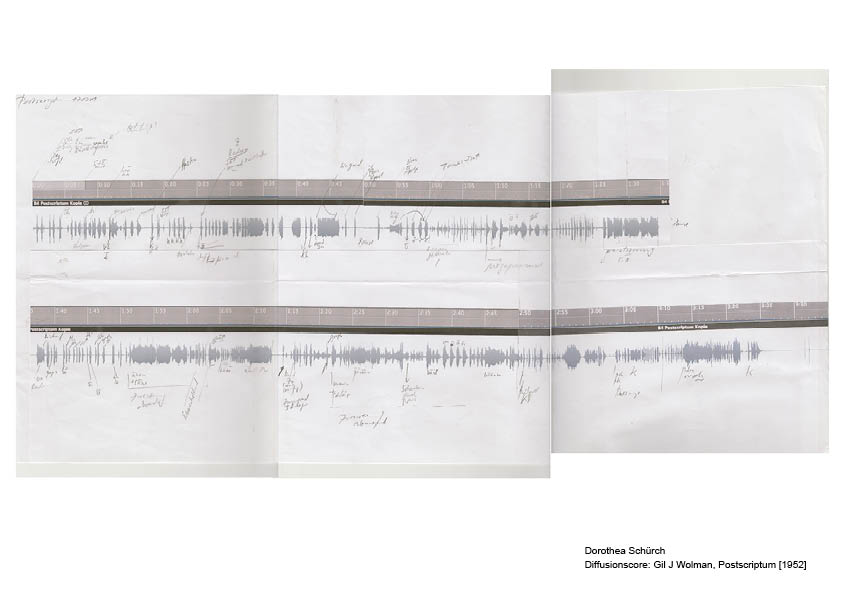
Audioscoring Postscriptum Wolman

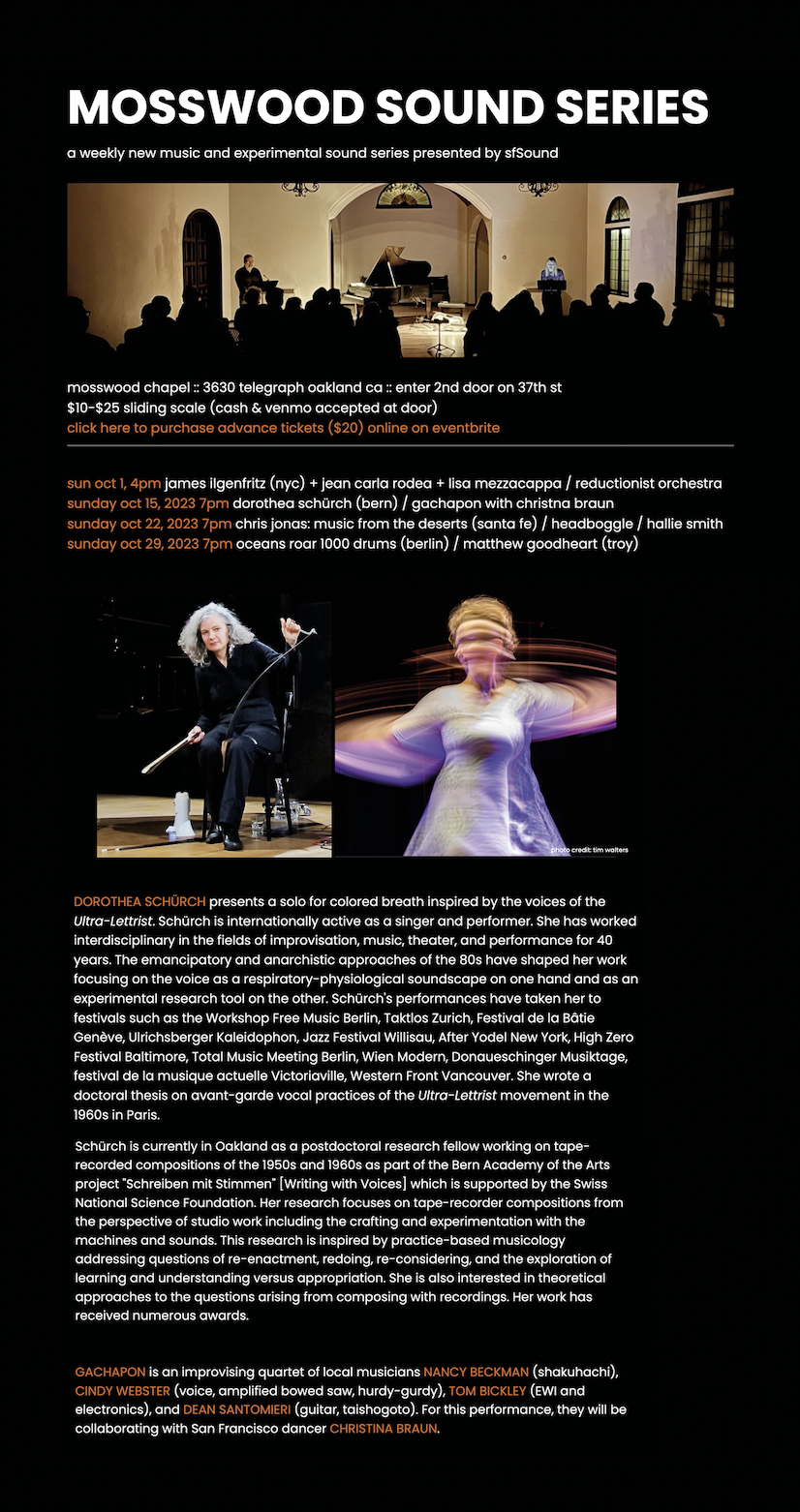
Mosswood Sound Series
Oakland, California
15. Oktober 2023
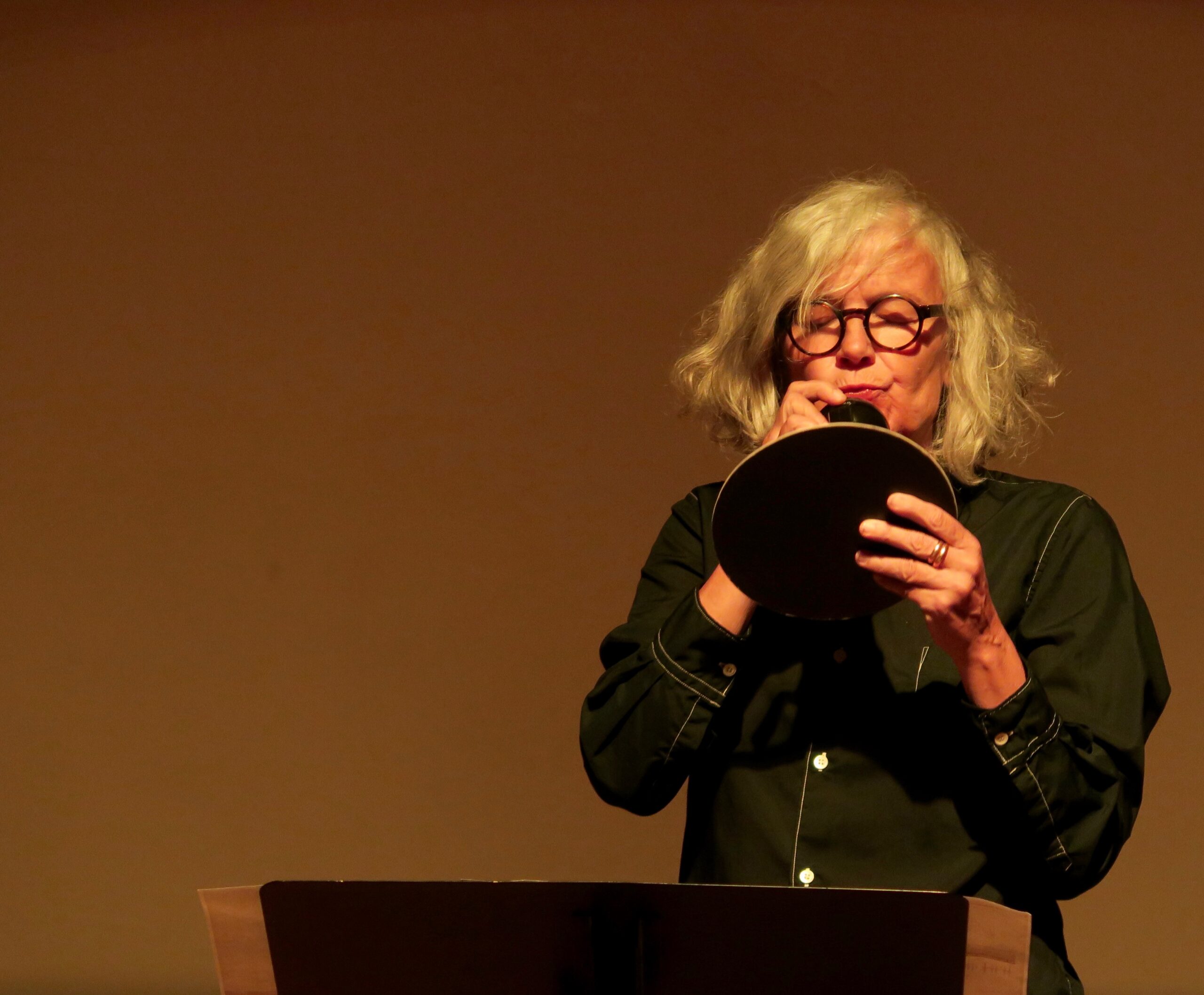
Mosswood Sound Series, Small Inner Spaces IX Audioscoring, 15. Oktober 2023, Foto©CorneliaCottiati

I
Pfeiffsumm

II Postscriptum (Audioscoring 1)
III palatal kkkk
IV Luftmegaphon
V Souffle (Performance)
VI Pfeiffsumm
VII palatal kkkk
VIII Postscriptum (Audioscoring 2)
IX Megaphonie

Material
Audioscore: Postscriptum, Gil J Wolman, 1952
Kopfhörer
Megaphon,
Schlauch, Plastikfolie
Mikrophonständer, Notenständer
Dauer: 31`

Introduction

[…] Lettrist poetry is essentially spoken poetry, and Isidore Isou (1925–2007) was its leader, with Gil J. Wolman (1927–1995) and François Dufrêne (1930–1982) being prominent members. Lettrists regarded poetry as the „Art of the Arts.“ I researched the lettrist and ultra-lettrist poetry by focusing on their performance practices, using my Audioscoring method. Audioscoring, as the name implies, involves listening to a score instead of reading it. I examined the experimental voices by learning from them, understanding how these voices are created, and documenting my observations in a studio logbook as I recreated what I heard. Tonight, I will perform tonight Postscriptum as an audioscore, a solo voice piece by Gil Wolman created in 1951. Postscriptum is three minutes long. In addition to the piece, you will hear breath and articulatory elements in line with Wolman‘s theory of Megapneumie, the theory of the Big Breath.

Screenshot

Small Inner Spaces VII
Audioscoring/Redoing (Phil Minton)

Galerie 26 Chaises
Paris, 18. Mai 2023


Small Inner Spaces VII Audioscoring/Redoing Phil Minton, Foto©CorneliaCottiati

I Intro [00]
II Sinus [8]
III Membran/Kazoo [9]
IV Atmung/close mik/Kazoo [12]
V palatal/ch [16]
VI Audioscore/Phil Minton [17]
VII Autro [24]

Material:
Kazoo plugged
Verstärker
MP3Player in Jackentasche
Audioscore Phil Minton: A Doghnut In One Hand
Dough Song 2, 3, 5, 7, 10, 11
Drainage Mr Wilkins
Dauer: 26`

Audioscoring wurde als praxisorientierte Forschungsmethode zur Analyse von extended vocal technics entwickelt. Im Rahmen meiner Dissertation Audioscoring & leere Stimmen: praxisorientierte Stimmforschung zu lettristischen und ultra-lettristischen Stimmexperimenten wurden Stimmaufnahmen der Ultra-Lettristen untersucht, die direkt mit Mikrophon auf Tonband aufgezeichnet worden sind. Graphische Notationen oder Verschriftlichungen ausgehend vom phoetischen Alphabeth gibt es für die der ultralettirstischen Stücke nicht. Die durch und durch sprachentfremdeten ultra-lettristischen Artikulationen entzeihen sich auch der Verschriftlichung. Abgesehen davon, dass die Notation durch die Aufzeichnung hinfällig wurde, wurde auch nicht von einer erneuten Interpretation oder Wiederaufführung ausgegangen. Im Gegenteil, diese wurde unterbunden. Was bleibt sind die Aufnahmen, die Artikulationen werden nie je wieder ausgeführt. Wozu auch? Mit dem Tonband sind die (vorerst) einmaligen Ereignisse in geradezu unheimlicher Detailtreue wieder und wieder abrufbar, die Einmaligkeit wird unendlich wiederholbar.
Small Inner Spaces VII stand im Zeichen von Covid. Die online Präsentationen der Covid-Jahren waren noch allgegenwärtig. In bester Erinnerung als Mangel-Ereignisse, die brüchigen weil schlecht synchronisierbaren Interaktionen, die fehlende Körperpräsenz, die Miniaturisierung und Verflachung durch die Präsentation am Bildschirm. Instabile Internetverbindungen, Zeitverschiebungen in der Übertragung, kleinste aber höchst irritierende Delays waren an der Tagesordnung. Nach dem Ende der Pandemie hatte der geradezu virulente mediale Mangelcharakter dieser Onlinedarbietungen einen merkwürdig langen Nachhall. Schufen die Stimmen im Kopfhörer, die Artikulationen in unmittelbarer Nähe zum Ohr, die geteilten-ungeteilten Räume nicht einen eigenen medialen Zauber, aus dem man, sobald die ZOOM-Sitzungen vom Bildschirm verschwanden, wie benommen erwachte?
In Small Inner Spaces VII wird Audioscoring nicht als Methode der praxisorientierten Analyse historischer Stimmaufnahmen präsentiert, sondern findet zum ersten Mal eine Anwendung im Bereich zeitgenössischer, experimenteller Stimmen. Inspiriert von den Präsentationsformaten der Pandemie wird Audioscoring jenseits von Interpretation zu einer Option, partiturlose Werke zur Aufführung zu bringen. Aber, im Unterschied zum Reenactment, das im letzten Jahrzehnt grosse Beachtung gefunden hat, im Sinn eines Re-doing oder En-acting.
Meine Anfrage ging an Phil Minton (*1940), London, Vokalperformer und Pionier der Improvisierten Musik. Die Auswahl fiel auf die Stücke Dough Song und Drainage Mr Wilkins der LP A Doghnut In One Hand. Es handelt sich um die erste LP mit Stimmimprovisation in meiner Sammlung.


Small Inner Spaces VI
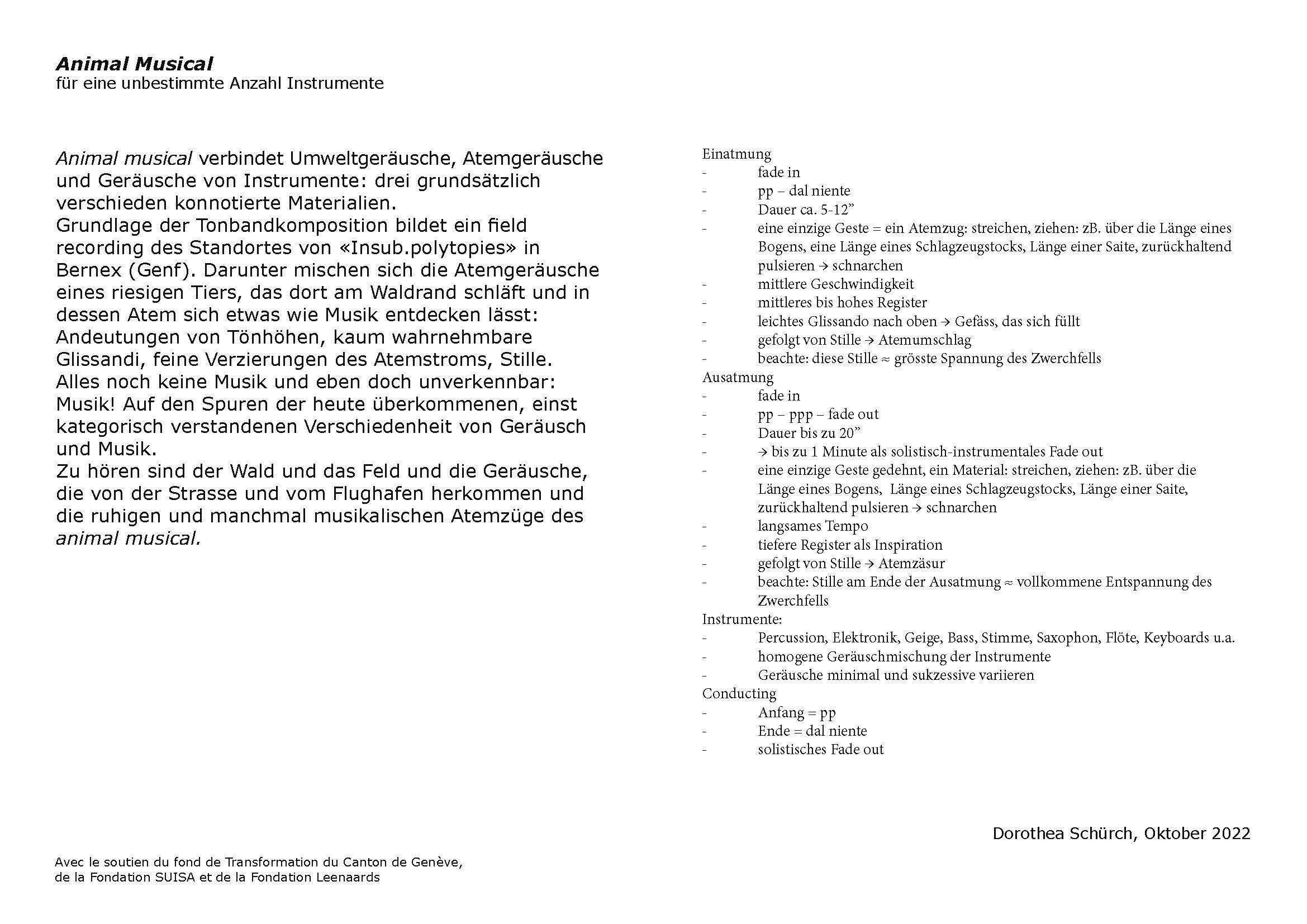
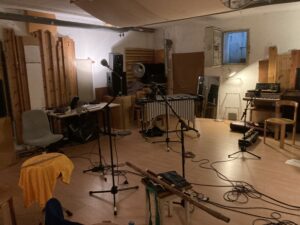
Animal Musical

«Insub.polytopies»
Bernex, Genf
2022/23

Christophe Berthet, ss
Cyrill Bondi, vibr
Raphael Ortis, voc
Rodolphe Loubatière, perc
Violetta Motta, flute
Dorothea Schürch concept, conducting
Dauer: 22:27

Animal Musical (Bandcamp)

101 Logbuch 230422 Boris Nieslony

→ leere Stimmen
zu Boris Nieslonys Performances mit Stimme

Artist Focus with Boris Nieslony
Video Chanel von OoS
das Interview führt Martine Viale
Out of Site Chicago (OoS) is an artist collective presenting outdoor performance art to inspire cultural dialogues about artistic ideas. OoS began in 2011 and in the pandemic we pivoted into being an international network and platform to present outdoor public performance art from around the world.

[…]
20’ – 33:30
1966 Bauarbeiter
Bücherkiste: Religion und Philosophy, Böhme u.a.
800 Themen gesammelt
Was kommt zu ihm, warten können, offen sein
Beziehung zu Steinen; er sei ein Stein
Film: B. steht vor dem Stein und atmet, er geht in den Stein, er sieht das Innere des Steins, es ist mehr als eine Meditation…?
Martine Viale: Boris arbeite mit Sounds like a language der Sinne…?
Er sei Teil der Natur, what is in my body, what is my voice [28’]
Wie kann man der Stimme Space geben ohne Sprache, direkt mit dem Körper verbunden
to present himself [his Stimme?], a direct link to his body
the voice makes a movement, the movement makes a voice
there is no memory [28:54]


Kunst Interviews zu führen


097 Log 230414 Schrift_Schreiben_Hören

Dez 1.2.
Schrift-Praktiken

Schrift: Skepsis bez. Schreiben

  • Aufzeichnung des Datums (Dufrêne oder Wolman) → Vergegenwärtigung
  • Schrift-Manipulationen

Schrift: nachgestellt, sekundär

  • Inschriften: Markierungen, die übrigbleiben
  • Hinweis-Zeichen (Index)
  • Grabinschriften
  • im Nachhinein, Festhalten, Berichten

Schrift: stummer/eigener Lautraum (zB Plakatgedichte/Hausmann)

  • Hausmann: fümmsv → für die «zusätzliche Dimension» der Schrift als Partitur interessiert sich das Archive Sonore (vgl. Tardieu / Inatheque) – die Alphabethschrift steht für eine offene Notation. Die Aufzeichnung des Vortrags (Autorenlesung) ersetzt dieses Potential durch ein einziges autorisiertes Recording der Autorenstimme.
  • Beachte : einerseites unzählige Versionen, schliesslich eine einzige

Schrift: Inbegriff des Hervorbringens (alles andere als nachgestellt)

  • Schöpfungsmythos
  • Derrida

Schrift: Schriftordnung / als Gesetz (Kittler)

  • Verschränkung von versch. Ordnungssystemen

Schriftpraxis mit Tonbandmaschinen
Oliveros: Tonbandmaschine und Akkordeon
Chopins → 020 Log 221128/29 Henri Chopin_sculpter le son
Dufrêne : Datum der Aufnahme aufzeichnen, automatisme maximum
Lucier: I am sitting in a room (auch eine Inschrift)
Gegenteil von Schreiben?
während das Tonband aufzeichnet


Tragödie des Hörens
230315 Mail von Micha
«→ Luigi Nono lässt in Prometeo – Tragödie des Hörens die unterschiedlichen Hörgewohnheit, des bildlich deutenden und des skandalös dialogischen Hörens, aufeinandertreffen. Tragödie des Hörens meint für den venezianischen Komponisten, dass Hören oft als Entziffern von Bedeutungen, als Zuordnung von Mustern missverstanden wird. Damit bleibt das schöpferische utopische Vermögen von Musik unentdeckt. Für den heutigen künstlerischen Umgang mit Medien ist relevant, dass Luigi Nono und der „Kurator seiner Libretti“, Massimo Cacciari, der Technik eine eigene Dimension zugestehen: „Die raffiniertesten Mittel der modernen Technologie (ein wirkliches `Instrumentarium`) zum Zwecke der Vervielfachung der Hörfähigkeit zu benutzen…“, ist ein programmatische Aussage Nonos. Das gilt für die hervorragende Technik des Experimentalstudios in Freiburg (Ringmodulatoren, Harmonizer (Audiocomputer), Vocoder; spezielle Quint-, Terz- und Sekundfilterbänke; Gates, Halaphon, Verzögerungsgeräte). Mit ihr hat Nono über Jahrzehnte gearbeitet.»