265 angela Snaeffelsjökuls rawling
interdisciplinary artist


…und dann wird ihre Beiteiligung kleingeredet, es heisst ihr Werk umfasse bloss einen einzigen Eintrag und dann wird der Titel erst noch falsch geschrieben. Ihre Namen gehen vergessen. Herstories wirkt all dem entgegen und verbindet die unzähligen Beiträge zu einem gigantischen Netzwerk der «female practitioners.»
…et ensuite, leur participation est minimisée et on dit que leur œuvre ne consiste qu’en une seule entrée et le titre est même mal orthographié. Leur nom est oublié. Herstories contrecarre tout cela et relie les innombrables contributions en un gigantesque réseau de » female practitioners. »
…and then their contribution is downplayed, their work is said to consist of only a single entry and the title is even misspelled. Their name is forgotten, Herstories counteracts all this and connects the countless contributions to a gigantic network of «female practitioners.»
265 angela Snaeffelsjökuls rawling
interdisciplinary artist
264 261002 Audioscoring BarDem Kommentar
for english please scroll down
Glamouröses Filmfestival Zürich. Dafoe sei eingeladen worden und also auch Carson. Das hingegen erstaunt mich. Womit konnte man sie überreden? Komparatistik, der Schwenk, der Cut, Arbeiten mit der Totalen? Warum sollte ich das wissen wollen. Carson ist gekommen und basta. Als auf meine Anfrage ein Kommentar von ihr im Chat auftaucht, habe ich mir ein Glas Wein eingeschenkt. Sie blickt kurz auf. Mit Schummeln ist bei ihr kein Durchkommen. Entweder du trinkst Wein oder du tauchst diesen fusseligen, alten Teebeutel ins heisse Wasser. Für ein Gespräch mit Carson nach Mitternacht ist der Tee recht bitter.
Ich möchte ihr erklären, was es Audioscoring auf sich hat. Sie sitzt unbequem auf dem Küchenstuhl. Yes, my dear, let’s hear. Das wird nicht lange dauern, fürchte ich. Mit Audioscoring formiere sich eine Art Zeugenschaft im Zuhören. Wie bitte?, so Carson. Mit diesem Tonfall muss ich erst fertig werden. Ich müsse mehr über das Konzept des Audioscorings herausfinden und über seine performative Umsetzung, auch musikalisch. Wie klug, wie schlau sind die Vorgaben? Oder nützen sich diese ab und verblassen zum Konzept? Was ist von den Stimmen auf dem Band zu hören? Ist das offenkundig misslingende Unisono eine gelungene Sache? Flinkes Hinterher oder flappsiges Immer-zu-spät. Was jetzt? Wunderbare Vergeblichkeit. Während die Aufnahme läuft, angespannt den Stimmeinsatz antizipieren. Und verpassen. Wie lange dauert die Atemzäsur? Synchronizität wird so nie gelingen – ein strukturelles Problem. Zwangsläufig scheitern. Aber der Versuch, dieses grossartige Trotzdem, geht das nicht zu Herzen? Dieser Wunsch das Timing zu verinnerlichen, sozusagen mit absoluten Zeitempfinden zu operieren, mit dem siebten Sinn. Woher diese Zuversicht? Naiv. Carson lässt sich nichts anmerken.
Sommerferien, Wandern, Schneeberge, Balkongeländer mit ausgefrästen Herzen, Aufsatzhefte im Schatten der Herzen. Es sind nicht meine Aufsatzhefte. Ich gehe noch nicht zur Schule, schreiben habe ich noch nicht gelernt. Das Heft liegt aufgeschlagen auf einem kleinen Tisch. Ich soll die Schnürchenschrift, die blaue Tinte nachziehen mit einem roten Bleistift. Doppellinien, auch die Satzzeichen. 32 Seiten, mit dem Löschpapier sind es 33. Dazu die Korrekturen und die Noten zum Schluss der Seiten. Sind sie rot, dann zeichne ich rot in rot. Stolz schreiben zu können. Es genügt, es fehlt nichts. Es schreibt.
Meist vergebliches Bemühen die Stimmen der Aufnahme in Echtzeit nachzumachen, aber Spass machts, sich eine andere Stimme einzuverleiben, als wäre es je möglich eine andere als die eigene Stimme zu haben. Was halten sie davon Frau Carson? Die stimmphysiologischen Verschiedenheiten treten offensichtlich hervor, Männerstimmen, Frauenstimmen, aber nicht immer: das Erstaunlich der perfekten Überlagerung, je mehr sie gelingt desto unhörbarer. Wenn Stimmen ineinander verschwinden.
Redoing, Reperformance, Verkörperung, ein durchschaubares Spiel mit der An- und Abwesenheit der Stimmen oder mehr? Carson sollte auch wissen, dass Audioscoring BarDem für das Festival BarDem manifest BarDem konzipiert wurde, auch im Wissen, dass Vincent und Jacques zuhören werden. Als Überraschung, für das Fest von BarDem, ein konkretes «manifeste» wie sich BarDem gewünscht haben. BarDem beim Wort nehmen. Carson rückt die Brille zurecht. Es fühlt sich in der Performance aber wie eine Grenzüberschreitung an. Kein gutes Zeichen. Worüber sinniert Carson? Ernsthaft, über Stimmenimitationen? Ich ergänze noch, es könne heikel sein, ein Tabu, Stimmen als Varianten ihrer selbst zu denken. Als etwas das gekapert werden kann, nicht nur von KI. Originale müssen mit Folgen rechnen, so das Ensemble Tzara, also auch die Stimmen, also auch die Stimmen von BarDem. Sie vergegenwärtigen sich in anderen Stimmen, verlieren ihren Status als einzigartige Stimmen. Sie werden zu Modellen. Das Erratische einer einzigartigen Stimme tauscht den Platz mit der einzigartigen Imitation.
BarDem pflegen eine ikonische Performancehaltung: in den ausgestreckten Händen die Partitur, Performance ohne eine Miene zu verziehen. Im Video ist zu sehen – soll ich es Carson zeigen? – wie unruhig und impulsiv und herausgefordert das Auswendiggelernte abzurufen ich bin, überfordert synchron zum Band zu agieren.
Audioscoring wird für jede Aufführung neu kalibriert. Audioscoring ist nicht gleich Audioscoring. Anne nickt, bis hierhin scheint sie gefolgt zu sein.
Glamorous Zurich film festival. Dafoe was invited, and so was Carson. That, however, surprises me. What could they have persuaded her with? Comparatistics, the pan, the cut, working with the wide shot? Why should I want to know? Carson came, and that’s that. When a comment from her appears in the chat in response to my question, I pour myself a glass of wine. She looks up briefly. There is no getting away with cheating with her. Either you drink wine or you dip that old, fuzzy tea bag into the hot water. For a conversation with Carson after midnight, the tea is rather bitter.
I want to explain to her what Audioscoring is about. She is sitting uncomfortably on the kitchen chair. Yes, my dear, let’s hear. This won’t take long, I fear. With Audioscoring, a kind of witnessing takes shape in listening. What? Carson asks. I first have to get past this tone. I have to find out more about the concept of Audioscoring and its performative realization, musically as well. How clever, how smart are the instructions? Or do they wear out and fade into a concept? What can be heard of the voices on the tape? Is the obviously failing unison a successful thing? Quick pursuit or flippant always-too-late. What now? Wonderful futility. While the recording is playing, tense, anticipating the voice entry. And missing it. How long does the breath caesura last? Synchrony will never succeed this way – a structural problem. Bound to fail. But the attempt, this magnificent nevertheless – isn’t there something moving about it? This desire to internalize the timing, so to speak, to operate with an absolute sense of time, with a sixth sense. Where does this confidence come from? Naïve. Carson doesn’t let it show.
Summer holidays, hiking, snow-covered mountains, a balcony railing with hearts cut out of the wood, exercise books in the shadow of the hearts. They are not my exercise books. I have not started school yet, I have not learned to write. The notebook lies open on a small table. I am supposed to trace the cursive handwriting, following the blue ink with a red pencil. Double lines, including the punctuation marks. Thirty-two pages; with the blotting paper, thirty-three. Then the corrections and the grades at the end of the pages. If they are red, I draw in red over red. Proud to be able to write. It is enough, nothing is missing. It writes.
Mostly a futile effort to imitate the voices from the recording in real time, but it’s fun to take another voice into oneself, as if it were ever possible to have a voice other than one’s own. What do you make of that, Ms Carson? The physiological differences between the voices become obvious – men’s voices, women’s voices – but not always: the astonishing thing about the perfect overlap, the more successful it is, the less audible it becomes. When voices disappear into one another.
Redoing, reperformance, embodiment, a transparent game with the presence and absence of voices, or more? Carson should also know that Audioscoring BarDem was conceived for the festival BarDem manifest BarDem, also knowing that Vincent and Jacques would be listening. As a surprise, for the celebration of BarDem, a concrete “manifeste,” as BarDemhad wished. Taking BarDem at their word. Carson adjusts her glasses. In the performance, though, it feels like crossing a boundary. Not a good sign. What is Carson musing on? Seriously, voice imitations?
I add that it might be delicate, a taboo, to think of voices as variants of themselves. As something that can be hijacked, not only by AI. Originals have to reckon with consequences, as Ensemble Tzara puts it – and so do the voices, so do the voices of BarDem. They become present in other voices, lose their status as unique voices. They become models. The erratic quality of a unique voice exchanges places with the uniqueness of its imitation.
BarDem cultivate an iconic performance stance: the score held in their outstretched hands, the performance proceeding without a flicker of expression. In the video, one can see – should I show it to Carson? – how restless and impulsive and challenged I am by having to retrieve what I have memorized, overwhelmed by the attempt to act in synchrony with the tape.
Audioscoring is recalibrated for every performance. Audioscoring is not the same as Audioscoring. Anne nods. So far, she seems to have followed.
261 261013 Donna Haraway
Staying with the Trouble
Haraway, Donna: Staying with the Trouble – Making Kin in the Chthulucene, Durham and London, Duke University Press, 2016.
Stichworte
Introduction (216: 1–8)
Chapter 1
Playing Sting Figures with Companion Species (216: 9–29)
Multispecies Storytelling and the Practices of Companions (216: 10–16)
California Racing Pigeons and Their People:
Collaborating Arts for Worldly Flourishing (2016: 16–29)
Becoming-with; Rendering-Capable (2016: 16–29)
PigeonBlog
Tauben und wie sie leben
– ein Hoch auf die Tauben und auf die pigeon people.
– Projekt by artist-researcher Beatriz da Costa and her students, 2006
– PigeonBlog = Tauben mit electronics auszurüsten (unter Absicherung der Animal Rights) um Daten zu Luftverschmutzung zu sammeln (?)
– viele Beteiligte (zB. animal rights)
– negociating skills etc.
Chapter 2
Tentacular Thinking
Anthropocene, Capitalocene, Chthulucene (2016:30–58)
eine Aneinanderreihung/Aufzählung/thinking with ihren littermates (2016: 31)
die Idee des Intanglements illustierend, nicht vertiefend, kommentiert sie die oben genannten.
den Faden verlierend
Anthropocene
Opening den Abschnitt mit fire, in 2015 einer anhaltenden Dürrezeit, creating fire-barriers (by fire), fire seasons, fire and the ongoingness
Geschichte des Begriffs Antropocene (2016: 44), urspünglich durch den ecologist Eugene Stoermer
Capitaloscene
Haraway verwirft Antroposcene als ein “tool, story, or epoch to think with” (2016: 49).
Chthulucene
“a thousand names of something else, to erupt out of the Antropocene into another big enough story.” (Haraway 2016:52)
Icon des Chthulucene: Potnia Theron with a Grogon Face Abbildung 2.6. gzder Potnia Theron/Melissa/Medusa, (Haraway 2016:53)
→ Geschichte von Medusa
Chthulucene ist die “third netbag for collecting up what is crucial for ongoing, for staying with the trouble” (Haraway 2016:55)
“We are humus, not Homo, not anthropos; we are compost, not posthuman. As a suffix, the word kainos, “-cene,” signals new, recently made, fresh epochs of the thick present. To renew the biodiverse powers of terra is the sympoietic work and play of the Chthulucene. Specifically, unlike either the Anthropocene or the Capitalocene, the Chthulucene is made up of ongoing multispecies stories and practices of becoming-with in times that remain at stake, in precarious times, in which the world is not finished and the sky has not fallen – yet.” (Haraway 2016:53)
Haraway findet in Chthulucene einen Weg für staying with the trouble, um nicht sagen zu müssen – zu spät! – um nicht zynisch werden zu müssen, Flechten, Korallen und Tentakelwesen als Vorbilder, Chthulucene ist unfinished.
Chapter 3
Sympoiesis – Symbiogenesis and the Lively Arts of Staying with the Trouble
(2016: 58–98)
Lynn Margulis (1938–2011)
Symbiogenesis
Symbiogenesis = making with – “Nothing makes itself” (2016: 58)
Lynn Margulis: autopoiesis, Gaia-Theorie
Beth Dempster: Sympoiesis
-1998 environmental studies graduate student
– Bakterien (aber auch Pilze) stehen als holents im Zentrum der Argumentation
Charles Darwin: On the Origin of Spieces, 1859
biological evolutionary theory
Margulis, ed. all untersuchen Zellen als multipartnered entities, komplexe Zellenprozesse, critters, holobioms, coral reefs, Bakterien
Nicole Kings, University of California. Berkeley
McFall–Ngai (“Diving the Essence of Symbiosis” and Edward (Ned) Ruby on squid bacteria
Die Titel dieser Publikationen sprechen Bände:
Interlacing Science and Arts with Involutionary Momentum
⇔ Zusammenfassung Introduction: (2016: 5)
“This chapter makes string figures with the threads of reciprocating energies of biologies, arts, and activisms for multispecies resurgence, Navajo–Churro sheep, orchids, extinct bees, lemurs, jellyfish, coral polyps, seals, and microbes play leading roles with their artists, biologists, and activists” (Haraway 2016:5).
Involutionary Momentum das Paper von Carla Hustak and Nathasha Meyers als Relektüre von Darwin und seiner “sensuous writing about his exquisite attention to absurdly sexual orchids” (Haraway 2016:68)
“Hustak and Myers argue that a zero-game based on competing methodological individualists is a caricature of the sensuous, juicy, chemical, biological, material-semiotic and science-making world.” (Haraway 2016:68)
…:
“In our experience of hearing, however, there is no inside and outside. Where, anatomically, our head should be, there lies the world. What then becomes of the ears? Have they, along with the head, dissolved into the ether? Or have they rather merged with our listening? If, as I have suggested, sound is not so much an object we hear as the underside of our own experience of hearing, and if this is what it means to be possessed of ears, then a walk in the woods on a stormy eve would find ourselves literally in a forest of ears, all around and above. Every creaking branch, every falling tree, every fold of the thunderous sky, would be listening to you, even in the passion of your listening to them. No one, of course, would be so foolish as to think that ears actually grow on the branches of trees, or that they float like flying saucers in the sky. This is not the point. It is a question not of anatomy, but of affect.” Tim Ingold: «Sound Walks», in: Biserna, Elena (ed.): Going Out – Walking, Listening, Soundmaking, Brussel, umland edition, 2023, S.250.
Weiterführendes Material
263 Log Listening_Tim Ingold
Konzert im Museum Morsbroich (Ausstellung mit Zeichnungen von Beuys)
Trio mit Hans Schneider und Erhard Hirt (oder Peter Van Bergen, oder Melvin, oder Quartett)? An die Wand gelehnt, mehr erinnere ich mich nicht. Anlehnen, viele Töne der anderen. Maggie – Maggie! – hätte zu tanzen begonnen. Kaum je weniger zu einem Konzert beigetragen (vgl. Poschiavo, Cool Jazz Festival mit 6ix?)
Konzert-Habitat, familiär verstummt, gefangen auf der Bühne, kein Davonkommen, an die Wand gelehnt, zuhören. Musik as a forest of ears: Teil eines worldings, oder ausgeschlossen? Was ist mit ihr?
250530
involution = Ineinanderfaltung, Verstrickung
“What is at stake in this involutionary approach is a theory of ecological relationality that takes seriously organisms’ practices, their inventions, and experiments crafting interspecies lives and worlds. This is an ecology inspired by a feminist ethic of “response-ability”… in which questions of species difference are always conjugates with attentions to affect, entanglements, and rupture; an effective ecology in which creativity and curiosity characterize the experimental forms of life of all kins of practitioners, not only the humans.” Hustak, Carla and Natasha Myers, “Involutionarty Momentum,” in: difference 23, no.3.2012, p. 77.
Darwins: «sensuous writing about his exquisite attention to absurdly sexual orchids» (Haraway 2016: 68)
Wenn Haraway Darwins „sinnliches Schreiben über absurd sexuelle Orchideen“ hervorhebt, will sie zeigen, dass Natur bereits bei Darwin als ein Geflecht von Verführungen, Affekten und Ko-Evolution erscheint. Die Orchideen werden zum Beispiel dafür, dass Leben nicht aus autonomen Individuen besteht, sondern aus Beziehungen, die Organismen gegenseitig hervorbringen.
Science Art Worldings for Staying with the Trouble (Haraway 2016: 71– )
“Each of these projects is a case of noninnocent, risky, committed “becoming involved in one another’s lives” ” (Haraway 2016:71)
“They are sympoietic, symbiogenetic, and symanimangenic.”
(Haraway 2016: 72)
Four critical Zones (Haraway 2016: 72–76)
Beschreibung von 1-4 siehe oben
Resurgence in Four Parts (Haraway 2016: 76–)
→ science art worldings for living on a damaged planet
THE CROCHET CORALL REEF (Haraway 2016: 76–81)
initiated by Margaret and Christine Wertheim (Brisbane)
THE MADAGASKAR AKO PROJECT (Haraway 2016: 81–85)
by Alison Jolly and Hanta Rasamimananana
NEVER ALONE (KISIMA INGITCHUNA) (Haraway 2016:86–89)
“world games” beruhen auf indigenen Geschichten und Praktiken = “worlding practices”
indigenes Wissen als unentbehrliche Perspektive auf “coming extinctions and exterminations”
→ indigenes Wissen teilen
“agency of multiple spirit helpers” (Haraway 2016:88)
→ vgl Ursula Le Guin: Always Coming Home
Wichtig
– Viviero de Castro’s Ausführungen zu Animismus als “sensibler Naturalismus”
– “Glaube” versus sensible science
– Endnoten nicht vergessen.
(Haraway 2016: 88)
“Working with Brazilian Amerindian hunters, with whom he learned to theorize the radical conceptual realignment he called multinaturalism and perspectivism Eduardo Vivieros de Castro wrote, “Animism is the only sensible version of materialism.” (Eduardo Vivieros de Castro, personal communication October 2, 2014) […] Belief is neither an indigenous nor a “chthulucenean” category. Relentlessly mired in both internecine and colonizing disputes of Christianity, including its scholarly and civic secular forms, the category of belief is tied to doctrine, profession, confession and taxonomies of errors. That is, believing is not sensible (siehe unten (1)). I am talking about material semiotics, about practices of worlding, about sympoiesis that is not only symbiogenetic, but is always a sensible materialism. The sensible materialisms of momentum are much more innovative than secular modernisms will allow. Stories for living in the Chthulucene demand a certain suspension of ontologies and epistemologies, holding the lightly, in favor of more venturesome, experimental natural histories.” (Haraway 2016: 88)
Endnote 72
That is one of the reasons that “belief” has nothing to do with the practice of the science. Sciences are sensible practices, in all their material semiotic workings, including mathematics and physics. Isabelle Stengers has been relentlessly cogent on this point; her love of Galileo’s inclines planes depends on understanding that science is sensible. Asking if one “believes” in evolution of climate change is a Christian question, in both religious and secular formats, for which only a confessional reply is accepted. In such worlds, Science and Religion reign and there it is impossible to play Never Alone. (Haraway 2016: 200)
260617
WEAVING: COMOLOGICAL PERFORMANCE, MATHEMATICAL RHYTHM, NAVAJO-CHURRO SHEEP, HÓZHÓ (Haraway 2016: 89–)
“Weaving is neither secular nor religious; it is sensible. It performs and mainfests the meaningful lived connection of sustaining kinship, behavior, relational action – for hózhó – for humans and nonhumans. Situated worlding is ongoing, neither traditional nor modern.” (Haraway 2016: 91)
→ künftige Tonbandgewebe
hózhó:
“A refrain from Navajo prayers often accompanies a weaver’s work: “With me is beauty” (shil hózhó); “in me there is beauty” (shii’ hózhó); “from me beauty radiates” (shits’ áá d óó hózhó). Hózhó is a central concept in Navajo cosmology and daily practice.” (Haraway 2016:90)
Das Kapitel schildert die traumatische Geschichte der Navajos (Vertreibung und Todesmärsche, Ausmerzen ihrer Schafe, Wiederansiedlung, Diktat des Handels mit Wolldecken, Sorten von Wolle und ihre Verwendungen – erst unter dem Terror kolonialistischer Siedlungspolitik, es folgen government scientists (science-Terror) – schwer vorstellbar, wie es sich als Navajo ohne Zorn und Hass leben lässt, unvorstellbar. Unerträglich, dieses Kapitel zu lesen. Vor diesem Hintergrund erscheinen künftige Webereien (Tonband) nichtig und dass sie sich erst noch erdreisten hózhó für sich in Anspruch zu nehmen, arg! = appropriation pure. So nicht.
statt Arragment (vgl. Eintragungen zu COMPOSITES in Saltport, Island)
– composit / composist
– compost
– critter
Chapter 4
Making Kin – Anthropocene, Capitalocene, Plantationocene, Chthulucene
(Haraway 2016: 99–103)
Begriffe für das heutige Erdzeitalter (Haraway 2016: 100)
Für das heutige und das kommende:
implying
including
“Evon rendered in an American English-language text like this one, Naga, Gaia, Tangaroa, Medusa, Spider Woman, and all their kin are some of the many thousand names proper to a veil of SF that Lovecraft could not have imagined or embraces – namely, the webs of speculative fabulation speculative feminism, science fiction, and scientific fact. It matters with stories tell stories, which concepts think concepts. Mathematically, visually, and narratively, it matter which figures figure figures, which systems systematize systems.” (Haraway 2016: 101)
Haraway speaks of herself as a compostist
Chapter 5
Awash in Urine – DES and Premarin in Multispecies Response-ability (Haraway 2016: 104–116)
Cyborg Littermates
(Haraway 2016: 104–105)
Begriff des Cyborgs
(weder das noch das noch das (Cyborg Zeit verpasst / Cyborg Neuling)
Cyborgs: “…post World War II information technologies and globalized digital bodies, politics, and culture of human and not-human sorts. Cyborgs are not machines in just any sense, nor are they machine-organism hybrids. In fact, they are not hybrids at all. They are, rather, imploded entities, dense material semiotic “things” – articulated string figures of ontologically heterogeneous, historically situated, materially rich, virtually proliferating relatings of particular sorts, not all the time everywhere, but here, there, and in between with consequences. Particular sorts of historically situated machines signals by the words information and system play their part in cyborg living and dying. Particular sorts of historically situated organisms, signals by the idioms of labor systems, energetics, and communication, play their part. Finally, particular sorts of historically situated human being, becoming-with the practices and artifacts of technoscience, play their part. Characterized by partial connections, parts do not add up to any whole; but they do add up to worlds of nonoptional, stratified, webbed, and unfished living and dying, appearing and disappearing. Cyborgs are constitutively full of multiscalar, multitemporal, multimaterial critters of both living and nonliving persuasions. Cyborgs matter in terran worlding. But Cyborgs are critters in a queer litter, not the Chief Figure of Our Times.” (Haraway 2016: 104f)
DES for Hot Peppers
(Haraway 2016: 105–110)
Inkontinenz / estrogen deficiency
DES = diethylstilesterol ist ein synthetisches Östrogen
Zur Verhinderung von Fehlgeburten, aber gar nicht zuverlässig der Fall
Gesundheitliche Folgen für die Kinder über Generationen hinweg
Entwicklung von DES, Diagnosen und Verschreibung von DES
DES Anxiety Syndrome: mit den langfristigen Folgen leben zu müssen
DES zeigt, dass Menschen keine autonomen Individuen sind, sondern durch Stoffe, Technologien, Geschichte und Verwandtschaftsbeziehungen miteinander verflochten.
DES-Politik: fragwürdige Verbindungen von Agrikultur-Wissenschaften, Farmer und Investoren
Wachstumshormone
Die Diskussion um DES und das «DES Anxiety Syndrome» berührt verschiedene Bereiche wie Medizin, Ethik, Recht, Gesellschaft und Politik. Haraway zeigt, wie Medikamentensicherheit und Patientenrechte im Laufe der Zeit stärker in den Fokus gerückt sind und wie die Erfahrungen von Betroffenen zu Veränderungen in der medizinischen Praxis und der gesellschaftlichen Wahrnehmung geführt haben.
Conjugating Kin with Premarin
(Haraway 2016: 110–114)
Urin von schwangeren Pferden/Zebras/Frauen für Big Pharma
Erst der grosse Markt, dann das grosse Desaster (Haraway 2016: 112)
“harvesting mare urine remains a worldwide business…”
HorseAid kontrolliert die Pferdefarmen (Haraway 2016: 113)
“In my DES story, tracking Cayenne’s urine spots to out-of-the-way places brought us into a still-expanding conglobulation of interlinked research, marketing, medical and veterinary activist, agricultural and scholarly body- and subject-making apparatuses. Digital and molecular species vied for attention with urethras and vaginas. Females in trouble seemed to luxuriate everywhere; even the industrially synthesized molecules seemed to respond to the lure (always nonreproductive, in this story) sexual tropisms despite decades of astute feminist wariness of so-called sex hormones. Cyborgs laughed. Do cyborgs get mitral valve disease or go through menopause? Of course they do, just like their kin.” (Haraway 2016:114f.)
Viral Resonse-ability
(Haraway 2016: 114–116)
→ Zusammenfassung und Übersicht über die Verwicklung/Oestrogen/Netzwerke siehe S.115
Chapter 6
Sowing Worlds – A seed Bag for Terraforming with Earth Others
(Haraway 2016: 117–125)
“Sowing worlds is about opening up the story of companion species to more of its relentless diversity and urgent trouble.” (Haraway 2016: 118)
to sow = säen
Auf Grundlage von Le Guin Carrier carrier bag theory
→ Bags, Schüsseln, Säcke, Gefässe, container, net, eine Muschel → Gründe genug eine(s) herzustellen aus meinen Tapes → vergleiche Composites (Saltport)
“Nonetheless, no adventurer should leave home without a sack.”
(Haraway 2016: 118)
Reines Prochaines and Friends: Memory Foam, Winter/Frühling 2027
The Hero trägt seine Beute/Trophäe nicht selbst nach Hause, lässt andere sie tragen. Er braucht keinen Beutel. Die Silouetten des Körpers nicht verunstalten. Die Handtasche lässt die Silouette intakt. Wessen Manteltaschen sind vollgestopft? Wer hingegen trägt nichts auf sich? Wer müht sich mit Le Guins carrier bags? Wer schleppt Säcke, Beutel, Lasten?
matter:
“Planting seeds requires medium, soil, matter, mutter, mother. These words interest me greatly for and in the SF terraforming mode of attention. In the feminist SF mode, matter is never “mere” medium to the “informing” seed; rather, mixed in terra’s carrier bag, kin and get have a much richer congress for worlding. Matter is a powerful, mindfully bodied word, the matrix and generatrix of things, kin to the riverine generatrix Oya.” (Haraway 2016:120)
Public AI: Oya in der Yoruba-Mythologie, einer afrikanischen Volksgruppe in Westafrika, insbesondere in Nigeria. Oya ist eine bedeutende Orisha (Göttin oder Geist) in der Yoruba-Religion, die oft mit Stürmen, Wetter, Veränderung und Transformation assoziiert wird. «Generatrix Oya» bei Haraway symbolisiert also die Kraft der Transformation und die Notwendigkeit, in einer Zeit des Wandels und der Krise aktiv an der Schaffung einer besseren Zukunft mitzuwirken. Es ist ein Aufruf, die Macht der Veränderung und des Wandels anzuerkennen und diese Kraft positiv zu nutzen, um eine nachhaltige und ethische Zukunft zu gestalten.
Therolinguism
Public AI: Es scheint, dass «therolinguism» eine Kombination aus «thero-» (bezogen auf Therianthropie, was die Identifikation mit Tieren oder das Gefühl, ein Tier zu sein, beschreibt) und «-linguism» (bezogen auf Linguistik oder Sprachtheorie) sein könnte.
Zur diesem Sprach-worlding gehören: language is communication, collective kinesthetic semiotics, chemosensory, visual and tactile language.
(Haraway 2016: 122)
Was ist mit dem “ways of knowing” der Pflanzen?
→ phytolinguists | CdG
Bsp: ants and Acacia verticulata
Chapter 7
A Curious Practice
(Haraway 2016: 126–133)
“Interesting research is research conducted under conditions that make beings interesting.”
Vinciane Despret
“To think with an enlarged mentality means that one trains one’s imagination to go visiting.”
Hannah Arend, Lectures on Kant’s Political Philosophy
(Haraway 2016:126)
Public AI:
Vinciane Despret ist eine belgische Wissenschaftstheoretikerin, Philosophin und Soziologin, die sich mit den Beziehungen zwischen Menschen, Tieren und der Umwelt beschäftigt. Sie ist bekannt für ihre kritische und kreative Herangehensweise an die Erforschung von Tier-Mensch-Beziehungen, die sich von traditionellen wissenschaftlichen Methoden und Diskursen abhebt.
Bibl. (Auszug)
– What Would Animals Say If We Asked the Right Questions?» (Despret 2016) – In diesem Buch untersucht Despret, wie wir mit Tieren kommunizieren und sie verstehen können, und wie wir unsere Fragen und Annahmen über Tiere und ihre Fähigkeiten hinterfragen sollten.
– Animals and the Shaping of Modernity» (Despret 2004) – Ein Beitrag zu einer Anthologie, in der Despret die Rolle von Tieren in der modernen Gesellschaft und Kultur untersucht.
– Habitus of a Bee» (Despret 2013) – Ein Essay, in dem sie die Komplexität des Verhaltens von Bienen und die Bedeutung von Bienen für unsere ökologische und soziale Welt untersucht.
Despret und Haraway teilen viele Interessen und Perspektiven, insbesondere in Bezug auf die Kritik an traditionellen wissenschaftlichen Methoden, die Betonung der Interdependenz zwischen Menschen und anderen Arten, und die Notwendigkeit, ethische und verantwortungsvolle Beziehungen zu Tieren und der Umwelt zu fördern. Beide sind in der Posthumanismus- und Animal-Studies-Debatte aktiv und haben sich gegenseitig beeinflusst.
Haraway über Despret
“Vinciane Despret thinks-with-other beings, human and not. That is a rare and precious vocation. Vocation: calling, calling with, called by, calling as if the world mattered, called out, going too far, going visiting. Despret listened to a singing blackbird one morning – a living blackbird outside her particular window – and that way learned what importance sounds like. She thinks in attunement with those she thinks with–recursively, inventively, relentlessly – with joy and verve. She studies how beings render each other capable in actual encounters and she theorizes – make cogently available – that kind of theory and method. Despret is not interested in thinking by discovering the stupidities of others, or by reducing the field of attention to prove a point. Her kind of thinking enlarges, event invents, the competencies of all players, including herself, such that the domains of way of being and knowing dilates, expands, add both ontological and epistemological possibilities, proposes and enacts what was not there before.” (Haraway 2016: 127f)
Despret bezieht sich auf die Verhaltensforscherin Thelma Rowell and “the virtue of politeness,” insbesondere in Bezug auf “to go visiting.” “Visiting is not an easy practice; it demands the ability to find others actively interesting […] to ask questions that one’s interlocutors truly find interesting, to cultivate the wild virtue of curiosity, to retune one’s ability to sense and respond – and to do all this politely.” (Haraway 2016: 127)
Interessanter Abschnitt zu “visiting”: es geht um Neugierde, um sich überraschen zu lassen, um produktive Missverständnisse, darum bereit zu sein, und „etwas interessantes“ zuzulassen, nicht zu viel vorwegzunehmen, um Intraaktivität. „Visiting is a subject- and object-making dance, and the choreographer is a trickster.” (Haraway 2016: 127)
Public AI
Thelma Rowell (1921-2015)
– war eine britische Biologin und Ethologin, die für ihre bahnbrechenden Arbeiten zur Verhaltensforschung, insbesondere bei Löwen, Hyänen und anderen afrikanischen Wildtieren, bekannt ist. Ihre Forschungen fanden überwiegend in der Wildnis statt, was zu ihrer Zeit ungewöhnlich war, insbesondere für eine Frau in der Wildtierforschung.
– Feldforschung: Rowell war eine der ersten, die langfristige Feldstudien über Löwen in ihrer natürlichen Umgebung durchführte. Ihre Beobachtungen zeigten, dass Löwen weitaus sozialer und kooperativer sind, als man damals angenommen hatte. Sie widerlegte die verbreitete Vorstellung, dass Löwen hauptsächlich Einzelgänger seien.
– Ethologie und Ethik: Rowell betonte die Notwendigkeit, Tiere in ihrer natürlichen Umgebung zu studieren, um authentische und nicht verfälschte Verhaltensweisen zu beobachten. Dies war ein wichtiger Beitrag zur Entwicklung der modernen Ethologie.
– Pionierin: Als Frau in einem von Männern dominierten Feld, war Rowell eine Pionierin und Inspiration für viele, die sich für die Feldforschung und insbesondere für die Verhaltensforschung interessieren.
– Publikationen: Obwohl sie zahlreiche wissenschaftliche Artikel und Berichte veröffentlichte, sind ihre bekanntesten Werke oft in populärwissenschaftlichen Büchern zusammengefasst, wie zum Beispiel «The Private Life of the Lion» (Rowell 1971), in denen sie ihre Beobachtungen und Erkenntnisse einer breiteren Öffentlichkeit zugänglich machte.
Tiere reagieren auf die Art und Weise wie sie beobachtet werden. Es gibt kein neutrales Aussen, keinen objektiven wissenschaftlichen Standpunkt: “with” nicht “on” (Haraway 2016: 128)
Zu Desprets Zusammenarbeit mit Jocelyne Porcher und den französischen Schweinezüchern ” (Haraway 2016: 129)
Isabel Stengers and Vinciane Despret: Women Who Make a Fuss: The Unfaithful Daughters of Virignia Wolf”
Chapter 8
The Camille Stories – Children of Compost
(Haraway 2016: 134–168)
Dreh- und Angelpunkt ist Stengers Kolloqium: gestes spéculatifs, Sommer 2013 in Cerisy
Im Sommer 2013 fand in Cerisy (Frankreich) ein Kolloquium statt, das von Isabelle Stengers organisiert oder geleitet wurde und sich mit dem Thema «Gestes Spéculatifs» befasste, insbesondere in Bezug auf spekulative Praktiken, Wissenschaftsphilosophie und die Rolle von Wissenschaft und Philosophie in der Gesellschaft. Isabelle Stengers, belgische Philosophin, die vor allem für ihre Arbeiten zur Wissenschaftsphilosophie, feministischen Theorie und spekulativen Praxis bekannt ist. Sie hat maßgeblich zur Entwicklung des Konzepts des spekulativen Realismus beigetragen, insbesondere in Zusammenarbeit mit anderen Denkern wie Bruno Latour. Stengers‘ Arbeit betont die Notwendigkeit, die Grenzen zwischen Wissenschaft, Philosophie und Alltagspraxis zu überschreiten, um neue Formen des Wissens und des Handelns zu erzeugen.
Das Colloque de Cerisy „Gestes spéculatifs“ (29. Juni–5. Juli 2013) ist ein wichtiger Bezugspunkt für Haraways Staying with the Trouble. Viele Ideen, die sie dort entwickelt – etwa response-ability, making kin, speculative fabulation und becoming-with –, entstanden im Austausch mit diesem Kreis von Philosoph:innen, Anthropolog:innen, Künstler:innen und Naturwissenschaftler:innen.
Weiterführendes Material
Blog des Kolloquiums
Intra-Being: Gestes Spéculatifs – Day 1
Gestes spéculatifs
Kolloquium
Centre Culturel International de Cerisy
29. Juni bis 5. Juli 2013
Isabelle Stengers
Didier Debaise
Publikationen:
Gestes spéculatifs, 2016, Presses du réel, Sammelband
Intra-Being: Gestes Spéculatifs – Blog
performancephilosophy.org
Gestes spéculatifs
praktische Denkbewegungen, die neue Möglichkeiten des Wahrnehmens und Handelns eröffnen.
Für Stengers bedeutet geste ein Tun, das eine Situation verändert.
Ein spekulativer Gestus fragt nicht: „Was ist wahr?“ sondern „Welche Beziehungen und Möglichkeiten werden durch dieses Denken oder Handeln hervorgebracht?“
Das ist ein deutlich pragmatistischer und prozessphilosophischer Ansatz, stark beeinflusst von Alfred North Whitehead.
Der Teilnehmerkreis war bewusst interdisziplinär: Philosoph:innen, Anthropolog:innen, Künstler:innen, Wissenschaftler:innen und Praktiker:innen arbeiteten gemeinsam an der Frage, wie Denken selbst zu einer Praxis werden kann. (Intra-Being). Zu den wiederkehrenden Themen gehörten:
Stengers‘ Eröffnungsvortrag
„Ferveur et lucidité – les obligations de l’instauration“
Haraway greift darauf zurück
1. Abstraktionen
– Abstraktionen sind unvermeidlich.
– Die Frage lautet: Welche Abstraktionen helfen uns zu denken und welche machen uns blind?
2. Ornières
– Schlüsselbegriff → Fahrspur, eingefahrene Denkspur.
– Viele Begriffe (z. B. „Fortschritt“, „Natur“, „Anthropozän“) funktionieren als solche Denkspuren.
– Ein spekulativer Gestus versucht, aus diesen eingefahrenen Bahnen herauszutreten.
– Intra-Being: Gestes Spéculatifs – Blog
3. Gaia
– Stengers unterscheidet ausdrücklich zwischen: Anthropozän und Gaia
– „Anthropozän“ beschreibt einen Zustand.
– „Gaia“ hingegen stellt eine Forderung: Wie antworten wir auf die Erde, die uns betrifft?
Haraway erwähnt das Cerisy-Kolloquium mehrfach, weil sie dort mit einem Netzwerk von Autor:innen arbeitete, die ihr Denken stark beeinflussten, darunter:
Cerisy als Laboratorium einer neuen Denkweise
Es geht nicht mehr darum, die Welt zu repräsentieren, sondern: Denk- und Erzählweisen zu entwickeln, die neue Beziehungen ermöglichen.
Geste spéculatif steht letztlich ein Denk- und Handlungsimpuls, der eine andere Weise eröffnet, mit Menschen, Tieren, Pflanzen und Dingen in Beziehung zu treten.
Für das Verständnis von Staying with the Trouble ist Cerisy deshalb weniger eine Tagung als ein gemeinsamer Denkraum, in dem Haraway, Stengers, Despret und andere eine relationale, prozessuale und ökologische Philosophie weiterentwickelten.
Imagining the World of the Camilles
(Haraway 2016: 137–144)
Niemand der Communities of Compost stellt sich vor in eine “empty land” zu ziehen, es “empty land” zu beerben – darauf beruhen kolonialistische Vorstellugen auf “empty land.” Die Children of Compost wissen, dass sie nirgends vorne anfangen können, es geht darum herauszufinden “how to live in the ruins that were still inhabited […], lived by a few simple but transformative practices” (Haraway 2016: 138)
Camille 1–
(Haraway 2016:144–)
[…]
weiterführendes Material
angela Snaefellsjökuls rawlings
www.arawlings.is
→ Ausstellung in Reykjavik
238 Log 250807 In Conversation with Toshie Kakinuma:
Jōji Yuasa, Takemitsu Tōru and Japanese Musique Concrète
September 16, 2025, Kunitachi Library, Tokyo
Toshie Kakinuma
Born in Shizuoka prefecture, Japan, Toshie Kakinuma is a distinguished musicologist, critic, and translator whose work centers on experimental and vocal music of the 20th and 21st centuries. She received her Bachelor of Music in Musicology from Kunitachi College of Music in 1977 and went on to complete her Master’s degree at Ochanomizu University in 1981. Pursuing further research abroad, she earned her Ph.D. in Music from the University of California, San Diego in 1989, where her doctoral studies focused on the American composer and instrument maker Harry Partch. Upon her return to Japan, Kakinuma held teaching positions at several institutions, including Meiji Gakuin University and Takushoku University, before joining the faculty of Kyoto City University of Arts as Professor of Musicology. At Kyoto, she also served as Director of the Archival Research Center, contributing significantly to the development of resources on contemporary Japanese and American music. Her scholarly interests encompass American experimentalism, modern Japanese composition, organology, and the intersections of sound, language, and the body. Kakinuma is the author of American Experimental Music as Ethnic Music (Film Art Sha, 2005) and The Birth of “Atonality” (Ongaku-no-tomo Sha, 2020, The 30th Yoshida Hidekazu Prize), has written extensively on figures such as Yūji Yuasa, Tōru Takemitsu, and Lou Harrison. In addition to her critical and scholarly output, she has produced influential Japanese translations of key 20th-century music texts, including John Cage’s Silence and Alex Ross’s The Rest Is Noise. When she wrote her essay “Yūji Yuasa and the Apparatus Called Language” (Ongaku Geijutsu, October 1984), Kakinuma was an emerging voice in Japan’s critical and academic circles, closely engaged with the evolving aesthetics of postwar vocal and electronic music.
In conversation with Toshie Kakinuma.pdf
Abstract
The conversation with musicologist and critic Toshie Kakinuma focuses on the vocal and electroacoustic works of Jōji Yuasa and Tōru Takemitsu, which she interprets as distinct Japanese articulations of musique concrète. Kakinuma situates these practices in dialogue with the European avant-garde – particularly Pierre Schaeffer, Luciano Berio, and Karlheinz Stockhausen – while emphasizing a critical divergence. Whereas Schaeffer’s concept of the objet sonore relies on analytical reduction and the suspension of linguistic meaning, Yuasa and Takemitsu pursue an approach that repositions the voice in a pre-semantic, corporeal register. The interview further addresses Kakinuma’s research on Takemitsu’s Vocal Trilogy, characterizing his engagement with musique concrète as explicitly anti-analytical. In contrast to European phonematic decomposition, Takemitsu conceives the voice as a bodily, everyday, and pre-aesthetic event, foregrounding experiential immediacy over structural abstraction.
Toshie Kakinuma:
Joji Yuasa and the Apparatus Called Language_Part I
Joji Yuasa and the Apparatus Called Language_Part II
Joji Yuasa and the Apparatus Called Language_Part III
238 Log 250807 Toshie Kakinuma:
Joji Yuasa and the Apparatus Called Language_Part I
Joji Yuasa and the Apparatus Called Language_Part I
Abstract Part I
Toshie Kakinuma’s essay “Jōji Yuasa and the Apparatus Called Language” analyzes the Japanese composer Jōji Yuasa’s 1969 tape piece Voices Coming as a radical experiment in the relationship between sound, language, and communication. Kakinuma situates the work within the postwar avant-garde tradition of deconstructing words and meaning – alongside Boulez, Berio, and Stockhausen – yet argues that Yuasa’s approach is distinct in its phenomenological rigor. Rather than mixing speech with electronic or musical sounds, Yuasa confines himself to unaltered recorded voices, exposing the hidden musicality of ordinary speech. By isolating interjections, conjunctions, and conversational fillers from everyday dialogue, Voices Coming strips language of semantic function and re-presents it as temporal and formal sound material. Through this process, habitual speech becomes defamiliarized: language, usually transparent and functional, regains perceptible form and duration. Kakinuma interprets this transformation as a double act – emptying everyday meaning while enriching non-everyday significance – and as a key moment in Yuasa’s broader search for a synthesis of poetic and musical temporality. The essay concludes that Yuasa’s work transcends the conventional boundaries of `music` and `vocal composition`, revealing how the human voice mediates between sound, meaning, and the possibility (or impossibility) of communication.
Toshie Kakinuma
Born in Shizuoka prefecture, Japan, Toshie Kakinuma is a distinguished musicologist, critic, and translator whose work centers on experimental and vocal music of the 20th and 21st centuries. She received her Bachelor of Music in Musicology from Kunitachi College of Music in 1977 and went on to complete her Master’s degree at Ochanomizu University in 1981. Pursuing further research abroad, she earned her Ph.D. in Music from the University of California, San Diego in 1989, where her doctoral studies focused on the American composer and instrument maker Harry Partch. Upon her return to Japan, Kakinuma held teaching positions at several institutions, including Meiji Gakuin University and Takushoku University, before joining the faculty of Kyoto City University of Arts as Professor of Musicology. At Kyoto, she also served as Director of the Archival Research Center, contributing significantly to the development of resources on contemporary Japanese and American music. Her scholarly interests encompass American experimentalism, modern Japanese composition, organology, and the intersections of sound, language, and the body. Kakinuma is the author of American Experimental Music as Ethnic Music (Film Art Sha, 2005) and The Birth of “Atonality” (Ongaku-no-tomo Sha, 2020, The 30th Yoshida Hidekazu Prize), has written extensively on figures such as Yūji Yuasa, Tōru Takemitsu, and Lou Harrison. In addition to her critical and scholarly output, she has produced influential Japanese translations of key 20th-century music texts, including John Cage’s Silence and Alex Ross’s The Rest Is Noise. When she wrote her essay “Yūji Yuasa and the Apparatus Called Language” (Ongaku Geijutsu, October 1984), Kakinuma was an emerging voice in Japan’s critical and academic circles, closely engaged with the evolving aesthetics of postwar vocal and electronic music.
Jōji Yuasa (1929–2024)
was a Japanese composer and one of the pioneers of postwar Japanese avant-garde music. He studied composition in Japan and Europe and was influenced by Western modernist trends (like Olivier Messiaen, Pierre Boulez, Karl-Heinz Stockhausen). He was known for his experimental, combining Western avant-garde techniques with Japanese aesthetics. He worked extensively with serialism, electronic music, and open-form composition.
Yuasa’s Work with the voice was an exploration of vocal timbre. He was interested in the human voice as a sound source, not just as a carrier of text or traditional melody. He often treated the voice like an instrument, exploring extended techniques (whispering, shouting, overtones, glissandi), integrating it in Musique Concrète and Electronic Music, experimenting with tape manipulation of the voice, cutting, layering, and processing vocal sounds to create textures and sonic landscapes. The voice became material for composition, abstracted from semantic content. He composed pieces for solo voice, mixed ensembles, and electronic setups. Vocal performances were often experimental, and performers had to explore unconventional sounds and interactions with electronics or tape. Like Tōru Takemitsu, Yuasa was interested in the “sound itself”, focusing on timbre, gesture, and expressive potential of the voice. The voice could evoke natural or bodily phenomena or serve as an abstract sonic object in avant-garde composition.
Jōji Yuasa is a central figure in postwar Japanese experimental music who treated the human voice as an instrument and sonic material, exploring both acoustic possibilities and electronic transformation. His work aligns with broader trends in Japanese musique concrète, emphasizing sound over meaning.
further reading:
Joji Yuasa and the Apparatus Called Language_Part II
Joji Yuasa and the Apparatus Called Language_Part III
238 Log 250807 Toshie Kakinuma:
Joji Yuasa and the Apparatus Called Language_Part II
Joji Yuasa and the Apparatus Called Language_Part II
Abstract Part II
Part II explores how Yuasa’s groundbreaking composition Voices Coming redefined the relationship between voice, sound, and meaning.
Yuasa used recorded human speech rather than newly produced sounds, emphasizing how voice inherently carries meaning. Through fragmentation and editing, he suspended meaning and broke down normal communication, turning language itself into musical material. Dismantling question–answer structures and expose the emptiness of habitual speech. Kakinuma compares Yuasa’s approach to Luciano Berio and John Cage, highlighting Yuasa’s distinct focus on the phenomenology of language. Over time, Yuasa expanded these ideas into live and instrumental works, maintaining speech-like rhythms even without actual words. The essay concludes that Voices Coming forms the philosophical and artistic foundation of Yuasa’s career, revealing how fragile and yet vital communication is in the modern world.
Toshie Kakinuma
Born in Shizuoka prefecture, Japan, Toshie Kakinuma is a distinguished musicologist, critic, and translator whose work centers on experimental and vocal music of the 20th and 21st centuries. She received her Bachelor of Music in Musicology from Kunitachi College of Music in 1977 and went on to complete her Master’s degree at Ochanomizu University in 1981. Pursuing further research abroad, she earned her Ph.D. in Music from the University of California, San Diego in 1989, where her doctoral studies focused on the American composer and instrument maker Harry Partch. Upon her return to Japan, Kakinuma held teaching positions at several institutions, including Meiji Gakuin University and Takushoku University, before joining the faculty of Kyoto City University of Arts as Professor of Musicology. At Kyoto, she also served as Director of the Archival Research Center, contributing significantly to the development of resources on contemporary Japanese and American music. Her scholarly interests encompass American experimentalism, modern Japanese composition, organology, and the intersections of sound, language, and the body. Kakinuma is the author of American Experimental Music as Ethnic Music (Film Art Sha, 2005) and The Birth of “Atonality” (Ongaku-no-tomo Sha, 2020, The 30th Yoshida Hidekazu Prize), has written extensively on figures such as Yūji Yuasa, Tōru Takemitsu, and Lou Harrison. In addition to her critical and scholarly output, she has produced influential Japanese translations of key 20th-century music texts, including John Cage’s Silence and Alex Ross’s The Rest Is Noise. When she wrote her essay “Yūji Yuasa and the Apparatus Called Language” (Ongaku Geijutsu, October 1984), Kakinuma was an emerging voice in Japan’s critical and academic circles, closely engaged with the evolving aesthetics of postwar vocal and electronic music.
Jōji Yuasa (1929–2024)
was a Japanese composer and one of the pioneers of postwar Japanese avant-garde music. He studied composition in Japan and Europe and was influenced by Western modernist trends (like Olivier Messiaen, Pierre Boulez, Karl-Heinz Stockhausen). He was known for his experimental, combining Western avant-garde techniques with Japanese aesthetics. He worked extensively with serialism, electronic music, and open-form composition.
Yuasa’s Work with the voice was an exploration of vocal timbre. He was interested in the human voice as a sound source, not just as a carrier of text or traditional melody. He often treated the voice like an instrument, exploring extended techniques (whispering, shouting, overtones, glissandi), integrating it in Musique Concrète and Electronic Music, experimenting with tape manipulation of the voice, cutting, layering, and processing vocal sounds to create textures and sonic landscapes. The voice became material for composition, abstracted from semantic content. He composed pieces for solo voice, mixed ensembles, and electronic setups. Vocal performances were often experimental, and performers had to explore unconventional sounds and interactions with electronics or tape. Like Tōru Takemitsu, Yuasa was interested in the “sound itself”, focusing on timbre, gesture, and expressive potential of the voice. The voice could evoke natural or bodily phenomena or serve as an abstract sonic object in avant-garde composition.
Jōji Yuasa is a central figure in postwar Japanese experimental music who treated the human voice as an instrument and sonic material, exploring both acoustic possibilities and electronic transformation. His work aligns with broader trends in Japanese musique concrète, emphasizing sound over meaning.
further reading:
Joji Yuasa and the Apparatus Called Language_Part I
Joji Yuasa and the Apparatus Called Language_Part III
238 Log 250807 Toshie Kakinuma:
Joji Yuasa and the Apparatus Called Language_Part III
Joji Yuasa and the Apparatus Called Language_Part III
Abstract Part III
The final part of Toshie Kakinuma’s “Yūji Yuasa and the Apparatus Called Language” examines Yuasa’s later vocal works – Projection on Bashō’s Haiku (1974), Projection on Onomatopoeia (1979), and Etude for “The” (1983). Kakinuma shows how Yuasa’s exploration of sound and meaning evolves into a deep engagement with the Japanese language itself: its phonetic energy, gestural character, and cultural resonance. Through these works, Yuasa transforms language into a field of play between voice and self, communication and noncommunication. His music thus reveals the voice as an apparatus mediating between individuality, collectivity, and the poetic essence of Japanese sound.
Toshie Kakinuma
Born in Shizuoka prefecture, Japan, Toshie Kakinuma is a distinguished musicologist, critic, and translator whose work centers on experimental and vocal music of the 20th and 21st centuries. She received her Bachelor of Music in Musicology from Kunitachi College of Music in 1977 and went on to complete her Master’s degree at Ochanomizu University in 1981. Pursuing further research abroad, she earned her Ph.D. in Music from the University of California, San Diego in 1989, where her doctoral studies focused on the American composer and instrument maker Harry Partch. Upon her return to Japan, Kakinuma held teaching positions at several institutions, including Meiji Gakuin University and Takushoku University, before joining the faculty of Kyoto City University of Arts as Professor of Musicology. At Kyoto, she also served as Director of the Archival Research Center, contributing significantly to the development of resources on contemporary Japanese and American music. Her scholarly interests encompass American experimentalism, modern Japanese composition, organology, and the intersections of sound, language, and the body. Kakinuma is the author of American Experimental Music as Ethnic Music (Film Art Sha, 2005) and The Birth of “Atonality” (Ongaku-no-tomo Sha, 2020, The 30th Yoshida Hidekazu Prize), has written extensively on figures such as Yūji Yuasa, Tōru Takemitsu, and Lou Harrison. In addition to her critical and scholarly output, she has produced influential Japanese translations of key 20th-century music texts, including John Cage’s Silence and Alex Ross’s The Rest Is Noise. When she wrote her essay “Yūji Yuasa and the Apparatus Called Language” (Ongaku Geijutsu, October 1984), Kakinuma was an emerging voice in Japan’s critical and academic circles, closely engaged with the evolving aesthetics of postwar vocal and electronic music.
Jōji Yuasa (1929–2024)
was a Japanese composer and one of the pioneers of postwar Japanese avant-garde music. He studied composition in Japan and Europe and was influenced by Western modernist trends (like Olivier Messiaen, Pierre Boulez, Karl-Heinz Stockhausen). He was known for his experimental, combining Western avant-garde techniques with Japanese aesthetics. He worked extensively with serialism, electronic music, and open-form composition.
Yuasa’s Work with the voice was an exploration of vocal timbre. He was interested in the human voice as a sound source, not just as a carrier of text or traditional melody. He often treated the voice like an instrument, exploring extended techniques (whispering, shouting, overtones, glissandi), integrating it in Musique Concrète and Electronic Music, experimenting with tape manipulation of the voice, cutting, layering, and processing vocal sounds to create textures and sonic landscapes. The voice became material for composition, abstracted from semantic content. He composed pieces for solo voice, mixed ensembles, and electronic setups. Vocal performances were often experimental, and performers had to explore unconventional sounds and interactions with electronics or tape. Like Tōru Takemitsu, Yuasa was interested in the “sound itself”, focusing on timbre, gesture, and expressive potential of the voice. The voice could evoke natural or bodily phenomena or serve as an abstract sonic object in avant-garde composition.
Jōji Yuasa is a central figure in postwar Japanese experimental music who treated the human voice as an instrument and sonic material, exploring both acoustic possibilities and electronic transformation. His work aligns with broader trends in Japanese musique concrète, emphasizing sound over meaning.
further reading:
Joji Yuasa and the Apparatus Called Language_Part I
Joji Yuasa and the Apparatus Called Language_Part II
222 Log In Conversation with Ian Stonehouse on Lily Greenham: Stranger in a Strange Land – Lingual music, Radiophonic Art, voice performance and conceptual art
Ian Stonehouse, British artist, educator, and researcher and experimental Music Archivist and former Head of the Electronic Music Studios (2004–2017) at the Department of Music, Goldsmiths, University of London, where he has taught since 1999. Trained in Fine Art at the University of Wolverhampton, he previously worked at London Electronic Arts (later the Lux Centre), collaborating with artists including Jane & Louise Wilson and Gillian Wearing. Since 2004, he has directed the EMS, focusing on electroacoustic composition, sound design, and media arts.
In Conversation with Ian Stonhouse.pdf
Abstract
This conversation with Ian Stonehouse (Head of EMS, Goldsmiths) explores the legacy of Lily Greenham (1924–2001), a pioneering sound poet, composer, and visual artist. It focuses on her invention of lingual music – a voice-based sound art form – and her collaborations with the BBC Radiophonic Workshop, notably the award-winning piece Relativity (1974). Stonehouse highlights Greenham’s multilingual performances, her technical mastery of tape editing, and her later shift toward electroacoustic composition in works such as Polar Polaris and Borges. The discussion also addresses her wide network of collaborators, challenges in archival preservation, and her lasting influence as an interdisciplinary artist who fused poetry, performance, and studio innovation.
More informations:
Ian Stonehouse’ article about Greenham on Wikipedia:
Lily_Greenham (Wikipedia) [accessed 29.12.2025]
Lily Greenham Archive [accessed 29.12.2025]
Badischer Kunstverein: Lily Greenham: Art of Living [accessed 29.12.2025]
Biography Ian Stonehouse [accessed 29.7.2025]
219 Log 250221 Score-Denken
Workshop «Diffraction Works – Score Workings»
by OOR Saloon in collaboration with Irene Revell
Sunday 2.3.2025 at Walcheturm Zürich
«Diffraction Works – Score Workings»
Ausschreibungstext:
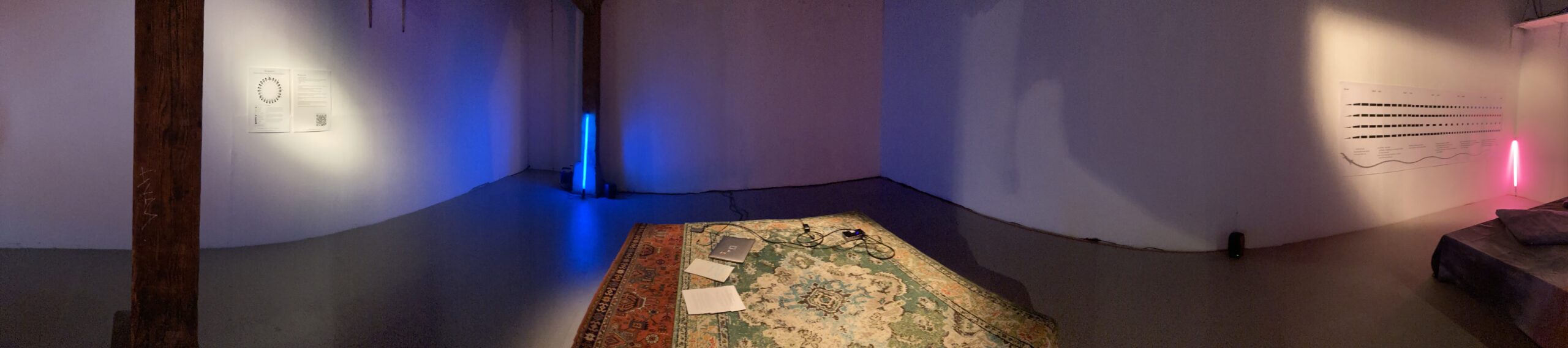
The event focuses on cosmologies of non-separability, attentive and situated listening, joint improvisation, reading and discussion. The format thinks itself diffractive with and through the scores as relational propositions for embodied political negotiations, as temporally non-linear possibilities of gathering otherwise.


Irene Revell
Her recent focus has been on the curatorial challenges posed by text instruction scores and related live ephemera, developing the workshop as a curatorial format amidst the wider notion of the embodied curator. She is interested in the development of such curatorial formats that may be iterative, extra-institutional, and of modest scale in terms of labour and other resources, she continues to research the use of text instruction in contemporary practices.
(zit n. Royal College of Art: Irene Revell und OOR Workshop)
weiterführende Links:
Her Noise Archive
Preemtive Listening
Alison Knowles und Annea Lockwood:
Score-Magazin-Projekt «Womens Work» (1975-8)
In 2019 with Primary Information Irene Revell republished Womens Work (eds. Alison Knowles & Annea Lockwood, 1975-8)
Irene Revell und Sarah Shin: Bodies of Sound: Becoming a Feminist Ear (Silver Press, 2024)
250303
Zusammenfassung und weiterführende Kommentare
situatives Hören ←→ analytisches Hören
Vgl. Recorder (Oliveros)
das Mikrophon (die Aufzeichnung) fokussiert nicht
während unser Hören störende Geräusche ausblendet (zB Flugzeuggeräusche)
weghören/wegschneiden/filtern
Musik
Diffraction: es geht nicht um Musik, sondern um geteilte Aufmerksamkeit für WINZIGE Momente
Partitur reduziert auf das Wesentliche
Video/Tape zeichnen ALLES auf
Fokus – stellt sich nachträglich, was ist wichtig?
der Score wird vorgetragen
um den Score auszuführen wird der Score vorgelesen
der Score, ungleich einer Partitur, kann nicht gleichzeitig gelesen und aufgeführt werden
der Score wird vorgetragen
wie spricht man zu 40 Leuten?
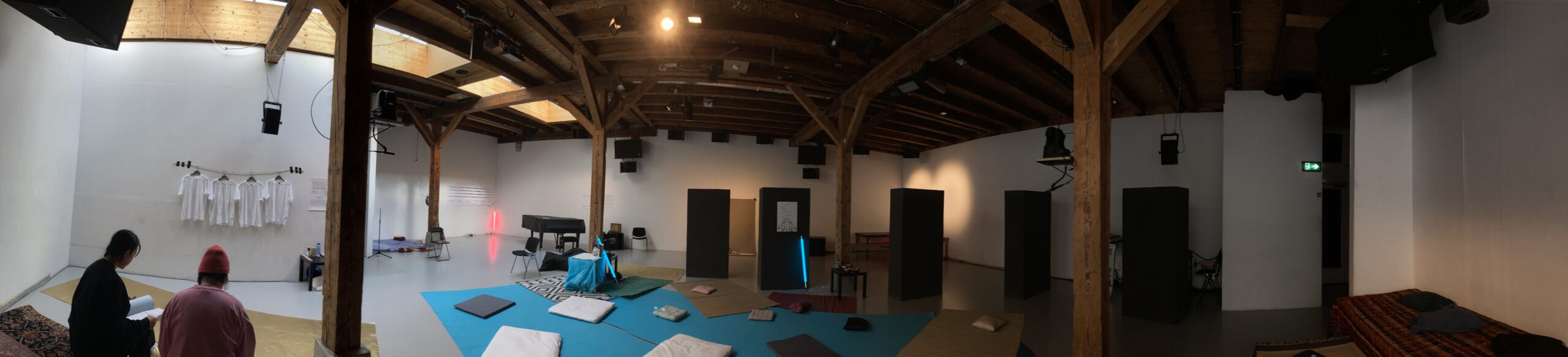
Versammlung vor dem Walcheturm unter der grossen Platane
in einem Kreis stehen
geschlossene Augen
eine Predigerin, die keine sein will und die sich unverhofft in dieser Rolle findet
liest vor
ausgestellt sein
Besucher/Zuhörer
Versch. Besuchende (IGNMVorsitzender(?), Mitveranstalter IGNM, Kurator Walcheturm)
Zuschauen/Besuch/Public werden ignoriert
eigentlich gibt es kein «aussen», es wird nichts geprobt, es sind keine Proben, weil es auch keine Aufführung gibt.
Bzw. keine Aufführung für ein Publ.
es geht ums Machen
merkwürdig unangenehm der Besuch
wird ignoriert
ansonsten wurde alles bedacht: auch eine Ruhezone
Unbeteiligter EH sitzt auf einem Stuhl
Was-ist-los?
der Score wird ausgesprochen leise vorgelesen, suggestiv, zart, empathisch
demonstrativ fein?
Müssten Scores auswendig gelernt werden, damit sie umgesetzt werden können?
Was ist mit den Zeitangaben?
nirgends eine Uhr
1 Minute, 2 Minuten, nur approximativ oder nicht?
auch drinnen sind die Score-Stimmen leise und weich
einschläfernd
Score
…einen Gegenstand in der Nähe in die Hand nehmen
seine Textur, sein Gewicht – was jetzt?
Textur oder Gewicht?
auch vor dem Walcheturm:
sich verbinden mit Tieren, Gräsern, Himmel
mit allen was (nicht?) da ist
oder liebhaben oder nicht lieb
sich verbinden – unverbindlich.
Warum nicht mit den Würmern?
Was kreucht und fleucht unter den Füssen
Vor lauter Auswahl keine Bestimmung, keine Ausrichtung
offen lassen zu offen lassend
im Sternzeichen der Ambivalenz
des Niemanden-mit-einem- Vorschlag einschränken
Space oder Raum oder Möbelierung
Die Räume bequem eingerichtet
eine Ecke um zu chillen, um sich zurückzuziehen
diese Vorsicht kippt zu einem Anzeichen könnte etwas hereinbrechen
Unwohlsein, Überforderung, ein langer Tag
wohlbedacht vieles vorwegnehmen und damit aber auch anwesend machen
Schluss
…dass alle vorbehaltslos mitgemacht hätten
da wäre keine Zurückhaltung spürbar gewesen, wie sonst oft
dass jemand, oft, öfters einzelne…hier, nein
well, es sind viele Leute und die einzelne Zurückhaltung zurückhaltend..
Fachjargon
Kein Fachjargon: decrescendo, pitch, was ist ein pitch?, ein Sound, Ton, Intervall, Puls, Rhythmus, keine musikspezifischen Begriffe herbeiziehen, um eine Partitur zu erklären. S’wird zwangsläufig langfädig, weil alles muss umschrieben werden. «Ich spiele nicht Klavier» they sitzen und drücken die Tasten. Nicht nur spielt they nicht Klavier (und tut es doch), they hört auch nicht was they spielen, damit beschäftigt die Töne zu drücken.
Es soll vermieden werden, dass jemand eine Erklärung braucht: was ist ein decrescendo? Anstatt einzuladen, dass die Leute hörend verstehen, was gemeint ist.
Scoring
Scoring ist allen zugänglich, keine Vorkenntnisse
im Workshop nennen sich die Vortragenden/facilitator
das hingehend ein Begriff der meine Alarmglocken läuten lässt.
Wie auch immer.
Lesend sind die Scores schwellenlos zugänglich
in der Aufführung gibt es doch wieder Dirigat, Zeigen und Zeichen und einige wenige die sich richtig freuen draufzuhauen.
172 Log 240712
Andrea Saemann: Saemann meets Schneemann – a performance thanks to Carolee Schneemann
Ludwig Jäger: ‚Aura’ und ‚Widerhall’. Zwei Leben des ‚Originals’ Urheberrechtsfragen in der Performancekunst
Urheberrechtsfragen in der Performancekunst
– Andrea Saemann: “Saemann meets Schneemann”, 2006
Mit einer Perf. hängen zs.
– wie wird Zitat in der Perf. / im Theater definiert?
– Def. re-enactment, Aktualisierung, re-doing, Wiederaufführung?
– wieviel Ähnlichkeit ist erlaubt, wann stellt sich die Urheberrechtsfrage?
– ist “Meeting Schneemann” (Andrea Saemann) bloss ein Verweis?
– oder gibt es ein genuines Interesse die Interior Scroll im Sinne einer Interpretation zu performen/aufzuführen?
– wie grenzt sich in der Musik Interpretation von Paraphrase ab, von etwas anklingen lassen…
– würden Perfs. den Status “interpretierbarer” Werks erhalten, was änderte sich?
– was beinhaltet «Status eines interpretierbaren Werks»?
– wenn sich Perf.-Kunstwerke wieder aufführen lassen, was bedeutet das für das Original?
«Jene reine Sprache, die in fremde gebannt ist, in der eigenen zu erlösen, die im Werk gefangene in der Umdichtung zu befreien, ist die Aufgabe des Übersetzers.“ (…) „Die wahre Übersetzung ist durchscheinend, sie verdeckt nicht das Original, steht ihm nicht im Licht. Sondern läßt die reine Sprache, wie verstärkt durch ihr eigenes Medium, nur um so voller aufs Original fallen».
→ Walter Benjamin: Die Aufgabe des Übersetzers, 1923
→ Walter Benjamin: Die Aufgabe des Übersetzers, 1923.pdf
– Das Original wird durch die Übersetzung «befreit»
– Die im Original gebannte «reine, eigentliche, ursprüngliche» Idee/Licht trifft zurück, verstärkt das Original
– gilt das auch f. «Interpretation», «re-enactment»?
Ludwig Jäger: ‚Aura’ und ‚Widerhall’. Zwei Leben des ‚Originals’ – Anmerkungen zu Benjamins Konzeptionen des Originalen
Abstract: Der Beitrag diskutiert zwei Aufsätze Walter Benjamins, die mit Blick auf die jüngere Original-Kopie-Debatte von großer Bedeutung sind. Benjamin hat in seinem ‚Übersetzer’-Aufsatz von 1923 und in seinem ‚Kunstwerk’-Aufsatz von 1939 zwei Begriffe eingeführt, die von hoher transkriptionstheoretischer Relevanz sind und die dort beide jeweils im Zentrum der Argumentation stehen: ‚Aura’ und ‚Widerhall’. Unter je spezifischer Perspektive fokussiert Benjamin anhand dieser Begriffe ein grundlegendes kunst- und medientheoretisches Problem – das Problem des Verhältnisses von ‚Original’ und ‚Fortleben’ des Originals, wobei ,Fortleben’ einmal als Übersetzung und zum anderen als technische Reproduktion verhandelt wird. Transkriptionstheoretische Überlegungen im Ausgang von diesen in Benjamins Werk zentralen theoretischen Begriffen erlauben es, das Verhältnis von ,Original’ und ,Kopie’ neu in den Blick zu nehmen. (zit.n. Jäger: Abstract, Link siehe oben)
Keywords: Original, Kopie, Widerhall, Walter Benjamin, Aura, Kunstwerk, Reproduktion, Übersetzung, Übersetzbarkeit, Fortschreibung, Transkription, Nachträglichkeit, Vorgängigkeit.
Musik
SUISA, Tantiemen, Musik am Radio ≠ Aufführung eines Stücks
Für die Pressung einer CD muss zwingend eine Anmeldung bei der SUISA vorliegen