007 Lieu de Recherche 221107
Studio Véronique Alain
Montag, 07.11. 11h

007 Lieu de Recherche 221107
Studio Véronique Alain
Montag, 07.11. 11h
006 Log 221106 Musique Concrète_Morphology_Typology_Theorie
Beatriz Ferreyra: «identification of sound characteristics»
Symposium presentation
Q-O2 workspace
voice and words group, 27/4/2019
transcript: …form late 50ties and late 40ties
Schaeffer had an idea that we can hear in a different way
away from the notes and the instrumental music as they knew it
perceives sound in a different characteristic
he made a solfège (1) to do the hearing in a different way
ex. instead of hearing a car you hear a complex sound
notes are tonic sounds / pitch
one day workshop about –> to do those characteristics for the voice
begins of becoming aware of all characteristics of the sounds, its form, continuum, complex sound high, low, medium, the don’t have a pitch but a material, forms, variations, impulses, staccatos
Schaeffer had the intelligence to give all these different names to the qualities of the sounds, change the name of doing the sounds: instead of staccato he speaks of imperative / interativ? = lots of impulses, tonic interativ
In den 60ties nobody knew how to compose with this sound.
There were no teachers
Schaeffer was not a teacher
Parmigiani was a genius, Malic, Ferrari everybody did his one sound, we did not copy, there was nobody to copy.
It’s very, very difficult to this sound with the voice, because it is very personal
It takes hours to make the sound move…
Difficult to change the sound characteristics, ex. from complex sound to iterative
–> exercises for compositions
–> sound is given by time and energy
–> three things are going on: breathing, timing, how it’s done»
Zum Begriff iterativ:
analytical toolbox: typo-morphology
[…] Arguably, it was not adopted within the English speaking world as a translation of Traité des Object Musicaux still does not exist. Fortunately a translation of Michel Chion’s book Guide des Objets Sonores, a book explaining Schaeffer’s theories in a slightly more manageable way, has been done by both John Dack and Christine North and can be found on the EARS website.
The Typo-Morphology framework
Chion discusses three stages in applying the typo-morphology of sound objects within the Guide Des Objets Sonores: identification (segmenting sound objects within a piece), classification (using the typology terms) and description (describing the sounds morphology in detail) (Chion 1994: 124).
Typology
Simply put, Schaeffer makes a distinction between two types of sounds: balanced sounds and unbalanced sound. Furthermore, he adds the idea of sustainment and iteration to expand the typology beyond simple impulses.
Balanced Sounds
Balanced sounds are identified because they have a «good compromise between the too structured and the too simple» and are comprehensible in short term memory (Schaeffer 1966: 435). Schaeffer makes it clear that there is a balance between both facture and mass in order to a sound to be considered balanced.
[Sounds should not be] either too elementary or too structured. If they are too elementary, they will tend to be subsumed by structures more worthy of memorization (…) If they are too structured, they will be capable of breaking down into more elementary object. (Schaeffer 1966: 435)
Schaeffer uses the letters N, X and Y to define the types of balanced sounds. N defines a tonic, or locatable pitch sound, X is used to refer to a complex sound and finally Y is used to describe a varying sound. To define whether they are a continuous, impulse or iterative sound Schaeffer uses apostrophes. A single apostrophe denotes an impulse, two apostrophes indicate an iterative sound and a letter without an apostrophe signals a continuous sound.
Unbalanced Sounds
Schaeffer once again separates unbalanced sounds into excentric sounds and redundant sounds. There are two types of excentric sounds, which are defined by their overtly complex mass, are: the large note (W) and the cell(K). Redundant sounds are described as balanced sounds that have had their duration extended «up to the point where every dynamic form disappears» (Schaeffer 1966: 448).
Typology
For reference here is the Typology table that has been translated from Guide Des Objets Sonores by John Dack and Christine North (2009):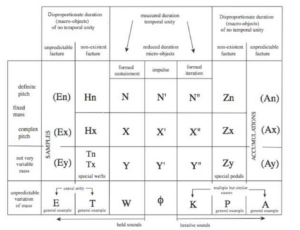
Morphology
Schaeffer outlines seven morphological criteria, some of which cross over within the typological framework: mass, harmonic timbre, grain, allure, dynamic, melodic profile and mass profile. All these terms are brought together within the Summary diagram of the Theory of Musical Objects.
Schaeffer also makes a distinction between whether a sound consists of composed (simultaneous) or composite (successive) elements. He then outlines a notational method to denote this. Any sound object can be defined by using the typology table and then further explained (by defining is composed and composite elements) by using brackets after the type letter. Commas are used to note composite elements and fullstops for composed elements.
How can it be used?
It is not entirely clear how it can be applied to an analysis. However, Lasse Thoresen has created a notation system for Typo-Morphology, which is documented over three successive articles within Organised Sound.
221106
Sonntag, Regenwetter, Küche Rue Beaurepaire
– Video, Fotos, Tonbandmaschinen –> räuml.
– LecturePerf
– Journal mit QR-Code
– Activating the tympanon by the voice
– Microphone studies = Membran studies, Membran vermittelte Prozesse
– Membran vermittelte Stimme (gehört), ohne Hören keine Stimme
– Mäander
Bibliothek IRCAM
– Paul Hegarty, philosophy of noise(s)
230424
Notizheft 43 221025–221219
Hegarty: Annihilating noise, Bloomsbury, 2021
Hegarty, 2021:105
Wie werden die Resultate der Experimente reflektiert?
(Hegarty, 2021:19)
fieldrecording 1960
(Hegarty, 2021:27)
“…brings sound experiences into audition. This followed the musicalisation of the world ..by..Cage, Oliveros and the availability of more portable machinery for recording. As machinery became simpler, smaller
Theory of the phonograph/Photograph by Pierre-Yves Macé (Hegarty, 2021:28):
rec. material re-presents an instance of the real, inconceivable apart from the demonstrable realness [charactrère réel] of a having taken-place of its referent / musical et doment scores
(Hegarty, 2021:28)
005 Log 221105
Schaeffer zur Musique Concrète
ProtagonistInnen der Musique Concrète
Pierre Schaeffer (1910–1995)
Pierre Schaeffer et Jacques Brissot à propos du festival de la recherche
Philippe NOIRET interviewe Pierre SCHAEFFER dans son studio de la rue de l’Université. Le directeur du Groupe de Recherches Musicales de la RTF explique en quoi consiste la musique expérimentale. En illustration à ses propos, le compositeur Bernard PARMEGIANI manipule une tringle et un archet avec lesquels il fabrique des sons. Pierre SCHAEFFER parle ensuite du «2ème Festival de la recherche» qui se tient à Paris, salle Gaveau. Jacques BRISSOT, se tient à ses côtés pour parler du Groupe Recherches Images qui se rapproche de la démarche du GRM. Diffusion d’un extrait du film de Jacques BRISSOT.
Schaeffer wird als „directeur de la groupe de recherche musicale de la radio française“ vorgestellt. Die GRM und in Folge die musique concrète sind Teil von Radio France. Schaeffer betont, dass auch in der musique concrète traditionelle instrumentale Gesten zu finden seien, es werde geschlagen und gezupft, wie bei anderen Instrumenten auch und anders als im Bereich der synthetischen Musik, der elektronischen Musik – die neuen Instrumente heissen Mikrophon und das Magnetophon. Das Video zeigt weiter Parmegiani mit Saiten, Blech und Bogen arbeitend und Xenakis, der von les „hasard, le alleatoire, le stochasique“ spricht. Zum Schluss ein Ausschnitt aus einem exprimentellen Film de la groupe GRI (groupe de recherche image).
Beatriz Ferreyra (*1937, Cordoba, Argentinien)
_ Interview 223010_221129 Beatriz Ferreyra
Personal site: Beatriz Ferreyra
Wikipedia: Beatriz Ferreyra
œuvres principales :
Mer d’Azov, étude aux itérations (1963)
Médisances (1968)
L’orviétan (1970)
Siesta Blanca (1972)
Canto del Loco (1974)
Petit Poucet magazine (1985)
L’OVNI de la Forêt (1986)
Souffle d’un petit Dieu distrait (1987)
Ríos del sueno (1998-2000)
Vivencias (2001)
Cantos de antes (2002)
La rivière des oiseaux (2003)
Dans un point infini (2005)
L’art de l’étude (2006)
La condition captive (2006)
Sourire de l’ange (2006) avec Christine Groult
Marche, quitte et va (2008) avec Christine Groult
Impasse (2008) avec Inés Wickmann
Les larmes de l’inconnu (2011)
Simone Rist (*1931 St. Etienne)
….est une soprano colorature. Elle a vécu et travaillé en France et en Allemagne, et ses concerts l’ont conduite dans toute l’Europe et en Amérique. Après ses études au Conservatoire de Paris dans les années 1960, elle a rejoint le Groupe de Recherche Musical dirigé par Pierre Schaeffer. Elle a eu l’occasion d’interpréter de nombreuses œuvres de compositeurs renommés tels que John Cage, Pierre Boulez et Luigi Nono. (zit. nach _ Interview 221208_230306 Simone Rist)
Champs mêlés, Companie Simone Rist
Förderverein deutsch-französischer Kultur
75 Log 230124 Simone Rist
29 Log 221208–230413 Simone Rist_Inathèque_ Dokumentation
Akira Tamba
Entretien avec Akira Tamba:
Interférences : du devenir à la création
journals openeditiond
Groupe de musique expérimentale de Bourges (GMEB)
Françoise Barrière (1944–2019, Paris)
Wikipedia: Françoise Barrière
[…] Françoise Barrière se rend alors à Bourges et est engagée comme responsable-animatrice du studio qui, avec ses quatre magnétophones, ses deux filtres et sa réverbe est une sorte de rêve pour une jeune compositrice.
Roger Cochini (*1946 Marseille)
Le Berry républican : «Pionnier de la musique concrète, Roger Cochini forme encore des musiciens aux beaux-arts», publié le 21/11/2018 à 18h00
Nicole Marie Lachartre (1934–1992)
Wikipedia: Nicole Lachartre
Œuvres
Pôttchô I pour flûte (1979)
Pôttchô II pour flûte (1979)
Babylone malade, ou la nuit du thermomètre, mini-opéra comique (1981)
Sonate Pour Alto (1964)
Sonate Pour Pianoforte (1965)
Suicide cosmique, pour bande seule (1974)
8 préludes, piano (1964)
Les chants de la tristesse: 6 mélodies pour soprano et orchestre (1964)
Des articles concernant la musique dans l‘ Encyclopaedia universalis, tome 11 (1968).
Les Chants de la Tristesse (1964)
005 Log 221105 Beatriz Ferreyra_QO2 workspace, Brussels, 2019
Beatriz Ferreyra: Identification of sound characteristics
Q-O2 workspace: workspace for experimental music and sound art
Q-O2 Workspace: Beatriz Ferreyra und Manfred Werder im Gespräch
004 Log 221104 Notizen
Andrea Saemann und Chris Regn
221104 ZOOM-Meeting
Vorbereitung Interviewbesuch bei Beatriz Ferreyra
mit
Andrea Saemann(2) und Chris Regn(3)
Protokoll: Andrea Seamann
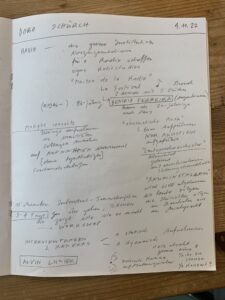
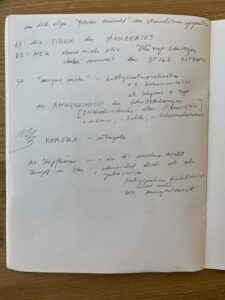
Weiterführende Links
003 Log 221029/30 Acousma Festival Konzert mit Beatriz Ferreyra
005 Log 221105 Beatriz Ferreyra_QO2 workspace, Brussels, 2019
006 Log 221106 Musicque Concrète_Morphology_Typology_Theorie
008 Log 221108 Beatriz Ferreyra_frühe Werke
017 Log 221128 Interview-Fragen Beatriz Ferreyra
020 Log 221129 Interview Beatriz Ferreyra
108 Log 230824 Entretiens avec Beatriz Ferreyra
168 Logbuch 240524 Heroines of Sound – Herstories
003 Logbuch 221106
IRCAM méthode de traitement du signal autour de la voix
Rencontre Journée de la voix IRCAM, Salle Stravinsky 20.10.22


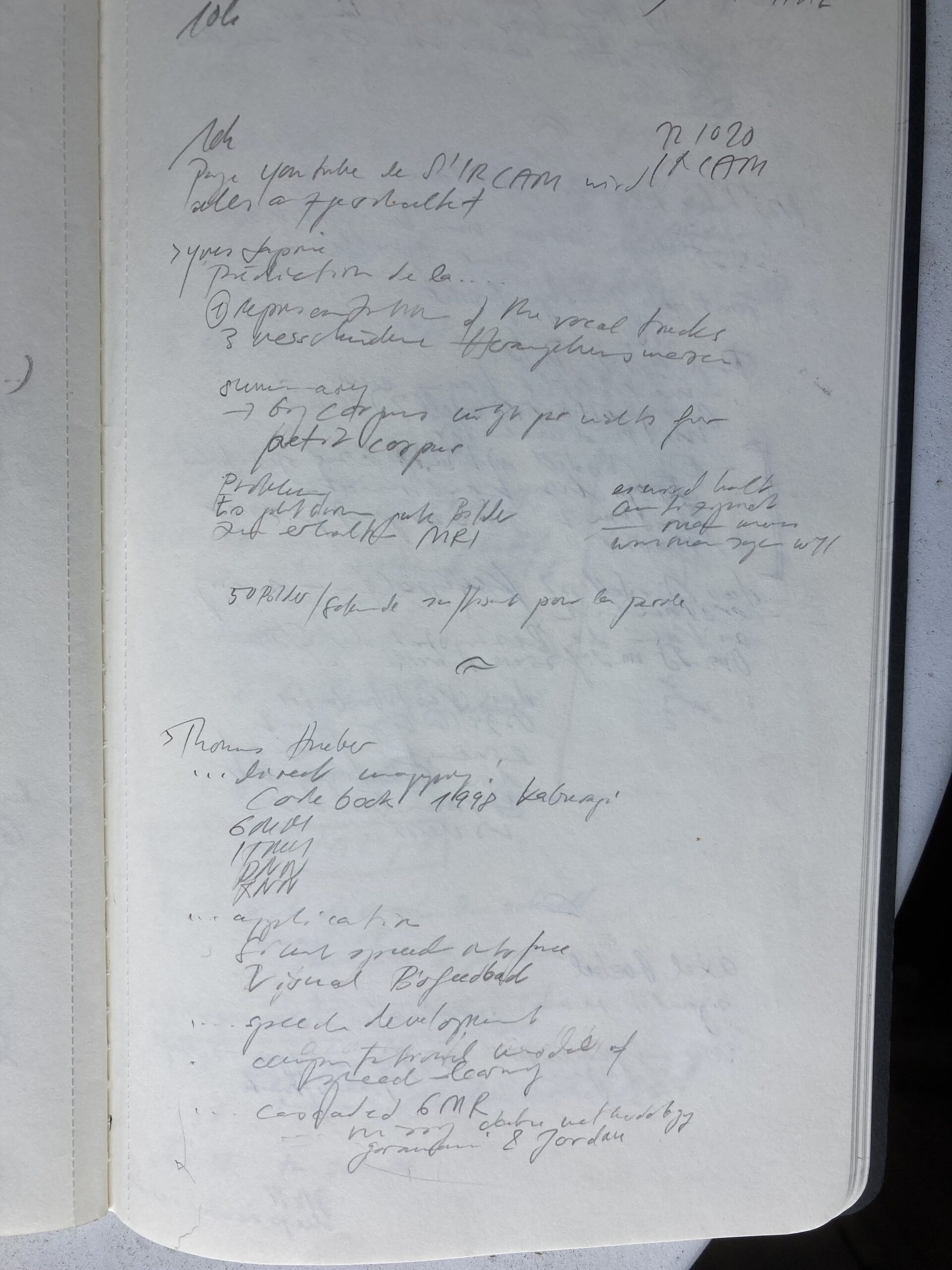
Seit dem Petersburger Preisausschreiben von 1781 dieselbe Herausforderung: die Stimme nachzubauen. Heute nicht mehr länger mechanisch (Kempelen), sondern digital, zB. mit einem Datensatz eines MRI. Problem: die ProbandInnen müssen im MRI zwar reden, sollten den Kopf aber nicht bewegen, unscharfe Bilder! Der Kopf muss festgeschraubt werden (Moulage?). Aus dem so gewonnen Datensatz wird eine Stimme nachgebaut. Beim Sprechakt werden die Silben antizipiert, die nachfolgende Silbe beeinflusst die vorausgehende, eine zusätzliche Schwierigkeit. Zum Schluss der Tagung lässt Axel Roebel ein KI auf der Grundlage von Sonogrammen eine Stimme generieren. Beide Ansätze werden seit dem Petersburger Preisausschreiben 1781 verfolgt: 1. der gennematische, der auf das Hervorbringen einer akustischen Struktur fokussiert und von der physiologischen Funktionsweise des Sprechinstruments absieht (Roebel). 2. der artikulatorische Ansatz, der „anhand einer maschinellen Rekonstruktion wissenschaftlich exakte Erklärungsmodelle für die menschliche Artikulation sucht.» Vgl Dissertation: Audioscoring & Leere Stimmen. Praxisorientierte Stimmforschung zu lettristischen und ultra-lettristischen Stimmexperimenten, S.207.
Ives Laprie
Directeur de la recherche au CNRS au LORIA à Nancy. Ses recherches portent sur la synthèse et la modélisation articulatoire, l’analyse de la parole et l’apprentissage du langage. Ces dernières années, il a essentiellement travaillé sur l’exploitation de données IRM temps réel.


Stimmen mit einem Bilder-Datensatz eines MRI nachbauen. Problem: die ProbandInnen müssen einerseits reden, sollten sich aber nicht bewegen, der Kopf muss festgeschraubt werden (Moulage?). Aus dem Datensatz errechnet ein KI eine Stimme. Problem: beim Sprechakt werden die Silben antizipiert, das heisst die nachfolgende Silbe beeinflusst die vorausgehende…
Thomas Heuber
Directeur de recherche au CNRS au GIPSA-Lab de Grenoble
Responsable de l’équipe de recherche CRISSP (Cognitive Robotics, Interactiver Systems, Speech Processig
Nathalie H Bernardoni
Directrice de recherche CNRS
De la théorie source-filtre aux interactions pneumo-phono-résonantiels: la compléxité de la voix humai
Axel Roebel
Directeur de recherche à l’Ircam et responsable de l’équipe Analyse et synthèse des sons.


weiterführendes Material im Archiv
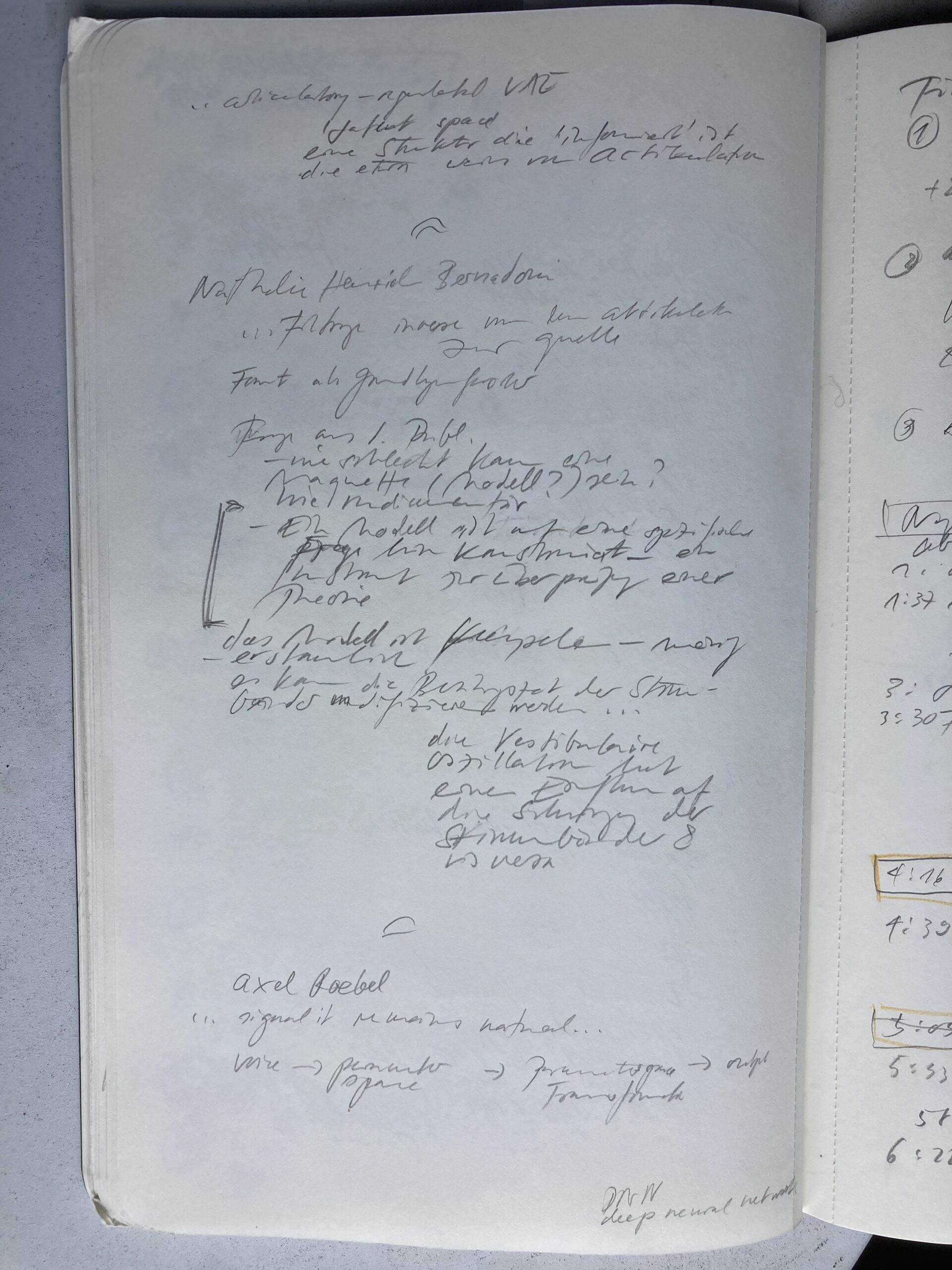
Notizheft 221020
03 Log 221106 Recording Studios der 1950er Jahre
Zürich–Paris 221102
Sound On Sound magazine
Inspired by Norman Petty and Sam Phillips, studio owner Dean Amos has lovingly built a perfect recreation of a 1950s recording studio — right down to the dimensions of the pegboard! We eavesdrop on a session at Sugar Ray’s Vintage Recording Studio to find out why it’s still valid to record an entire band to tape, with one microphone. Sound Engineer Lincoln Grounds and the band reveal the challenges they faced when recording this way. In this experiment rockabilly band Race With The Devil record in a variety of vintage styles. Starting with only a single microphone in the live room, more microphones are added throughout the session. Compared to modern multitrack recordings, we see the differences and challenges faced in recording music the way they did back in the 1950s. See the interviews and session in the video above and download the recordings on youtube.
Recording in the ’50s Style
00:00 – Intro…the honesty of it….
01:32 – Initial Thoughts On The Studio Space….the immediacy of it…especially on a vocals… it appeals to people…that’s the magic of it, instant gratification
02:25 – Single Microphone Set-up
03:45 – Dean Amos: Sugar Ray’s Studio
05:36 – Single Microphone Recording….working with the dead spots of a mik
09:12 – Recording With 2 Microphones
10:48 – Vintage Studio Hardware
17:17 – Using 3 Microphones
18:14 – Vintage Microphones ….echosystems: Phillips used two tape recorders
21:38 – Recording With 4 Microphones
24:29 – Importance Of Performance Ability
28:33 – Artist’s Thoughts On The Studio Environment
29:39 – Lincoln Grounds’ Final Thoughts
34:24 – Future Of Vintage-Style Recording
Shure Microphones:
RCA 44 Mikrophon
FatBoy 55 / 355
RCA 74 Mikrophon
03 Logbuch 221106 Acousma Festival
221029
Mi: Bibliothek IRCAM 14-18h30
Do: Bibliothek IRCAM 14-18h30
Fr: Maison de la Radio, Kontakte und Recherche zur Geschichte der Akusmatik
Sa: Acousma Festival 29.+30. Octobre 2022
maison de la radio, studio 104
Das Publikum sitzt (ergriffen?) vor dem Acousmonium. Auf das Dimmen der Saallichter folgt einen Moment lang eine (ich: falsche?) Andacht: Stille. Auf der Bühne im Halbdunkel Lautsprecher, Kabelschlangen, eine Akustikwand, da und dort ein leuchtend roter Punkt – on/off – Lautsprecher: doch! mit rundem Gesicht! Im schummrigen Schweinwerferlicht, in den Reihen des Publikums das Mischpult: la spatialisatation. Du sollst nicht vor niemandem ergriffen sein. „Stay still!“ lässt die Komponistin am Ende des ersten Stücks eine Stimme sagen: „sie führen uns in einen riesigen Raum, dann sagen sie: stay still!“
003 Lieu de Recherche 221029/30
Acousma Festival
29. / 30. 10. 2022
maison de la radio, studio 104, Paris


.
.
Small Inner Spaces V
Uncanny Silences – Performative Mutness
Symposium
Le son dans l‘art performance
– une épistémologie Intermédia
[Pleine association en mode composé*]
Musée des beaux arts & d`archéologie, Besançon
6. April 2022
Uncanny Silences – Performative Mutness
selon Gina Pane
Action Autoportrait(s), mise en condition / contraction / rejet, 11. janvier 1973
Material
Teil I
Powerpoint Präsentation
Textkarten
Teil II
Spotlicht
Notenständer
Score
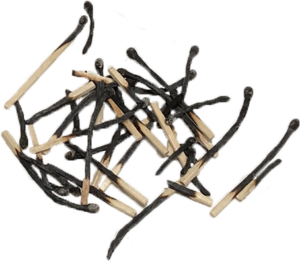
Streichhölzer
Dauer: 30‘
Uncanny Silences – Performative Muteness focuses on a voice that cannot be heard because it is held back, suppressed. A voice that evokes an uncanny silence. A performative muteness, a silence that can be felt, a physical silence, an audible absence that makes all the sounds stand out all the more. At the center of Small Inner Spaces V is the performance „mise en condition“, „the conditioning“ from January 11th, 1973 by Gina Pane, the French born performance artist who lived and worked in Paris and was a member of the 1970s Body Art movement „Art corporel“. The following description of „the conditioning“ commenting on the series of photographs of the performance underlines the silence in which the action took place, highlighting the spreading of the muteness: “In The Conditioning Pane enters a room with a metal bedframe positioned over two rows of burning candles. She lies fully clothed atop the frame and does not move or speak.“ The photographs documenting the performance at the Rodolphe Stadler Gallery in Paris built the basis of Small Inner Spaces V.
Performance Score: